In this new series, we are shining a light on some of the amazing people who work in our VICTVS Global Network. With over 5,000 members worldwide, our network is filled with inspiring individuals making a difference every day, and we hope highlighting their incredible stories and achievements will inspire you.
In this first interview, we shine a spotlight on Stella Mwangi and her extraordinary journey.
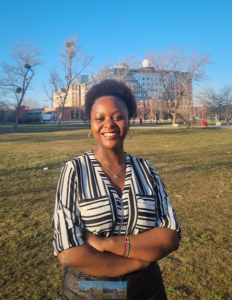
You’re originally from Kenya but moved to Hungary, I can imagine that involved a lot of courage. What made you decide to move to Hungary?
Moving to Hungary was a bold step and actually my first time outside Kenya, so it was exhilarating and I was full of curiosity about the world beyond Kenya. I always knew I wanted to do a Masters abroad – or as we Kenyans love to call it, ‘majuu’- with Europe as my top choice. So, during scholarship application season, my first option was a Masters in the UK and my second was Hungary.
Unfortunately, my UK masters scholarship was rejected, but my Hungarian one was accepted. However, I have grown so fond of Hungary – Budapest in particular- and it feels like everything worked out exactly as it was meant to. Now, I am pursuing my Masters in Environmental Science in the biggest university here and it still feels surreal that my dreams came true and I’m officially the girl in majuu!
What made you want to study sustainability and can you tell me some more about the work that you do?
In my growth as a community advocate, witnessing a myriad of challenges facing society, I’ve seen that it’s necessary to gain more knowledge on sustainability and the environment to gain science-backed solutions for vulnerable communities.
As humans, we are heavily reliant on natural resources for our survival, and unsustainable use has major implications leading to issues such as lack of food and water – especially in developing nations. It is a delicate balance that requires in-depth knowledge on different aspects of the ecosystem to ensure we have access to basic needs whilst maintaining a healthy environment. I’m striving to learn and apply this knowledge to improve the quality of life for different communities, and I’m doing that in the water project I have back in my hometown Nakuru.
What does your work in Nakuru involve, and how does it feel to be giving back to them?
I am currently working on a water project aimed at increasing access to clean drinking water for an informal settlement in Nakuru town. For context, the project is based in the PISTIS Home for the destitute, which doubles as an orphanage and school, and is located in the Rhonda informal settlement. Unfortunately, our school borehole water is unfit for direct consumption due to impurities and other issues such as high fluoride levels, and this is a health hazard to the students and community, risking water borne diseases and other disorders such as dental fluorosis from the high fluoride levels.
This is how the idea to start the project came about as we realised by filtering the water, we can also sell to the people in Rhonda at an affordable rate, as the community also struggles to access clean water – the profits from the project can then be used to support the children at the home, since most are from disadvantaged backgrounds, and others are total orphans who board there. We also plan on selling the water to other institutions in the larger Nakuru area to ensure the project can sustain itself.
We applied for a grant to fund the project as it is quite expensive procuring the machines, and this is how we’ve been able to run the project. I am indebted to my amazing team who have made sure it is running strong, even while I am away.
It is deeply fulfilling to know that this project will protect the health of the kids and the community at large. Being made aware of the effects of excess fluoride in my Environmental Science studies and unsafe water in general, I am happy that I play a part in ensuring kids teeth are protected, as dental fluorosis begins at the developmental stage. As William Arthur Ward once said, “a warm smile is the universal language of kindness” – to me, there’s nothing more rewarding than helping create those smiles and ensure healthy living.
What’s one thing you wish more people knew about you?
That despite being a community advocate, I still struggle with stage fright. One of my proudest moments was when I presented on a global stage in Copenhagen for a climate caucus, with the event also being live streamed. You can bet I was extremely nervous before my turn, but seeing myself on that stage, quite composed and advocating for millions of African students, is a moment I truly cherish. I am immensely proud that I pushed myself to do that. I also owe it to my friends and colleagues who believed in me and nominated me to be the speaker that day.
I am still working to overcome my stage fright and I’ve gotten much better in my presentations, even at school. By the time I’m doing my thesis defense, I’m sure I’ll have shown immense growth.
So, this is your sign to do it scared, do it nervous, and you’ll be surprised at what you’re capable of.
What are some current goals that you’re working towards?
Besides successfully finishing the water project and my masters degree, I am working towards learning more about water filtration techniques in Europe and different methods that water quality standards are adhered to, especially those that would also be applicable back home. Being in a different country and continent offers a fresh perspective on other working solutions.
I want to build a scalable model that can be adapted by other regions while collaborating with those who are in water safety projects in other vulnerable communities, as PISTIS is just one of many. Now, with climate change worsening natural resource scarcity, there is more need to build resilient communities. It is worthwhile to note that climate change is also disproportionately affecting women and girls, especially in communities with pre-existing gender inequalities, and so access to basic needs such as clean water also ensures their safeguarding.
