
Why Invigilation Matters to your Candidates

A photo of students sat in an exam hall taking an exam with their backs to the camera.

Exam invigilation has long been considered a casual side job – something a family member might do as a favour to a student’s school.  Growing up, I certainly never viewed my exam invigilators as professionals.  Instead, they were familiar faces, a source of comfort rather than authority.

These days, my perception of invigilation has shifted drastically.  Working at VICTVS, I have seen first-hand the rigorous training invigilators undergo and understand that this is a legitimate profession requiring complex skills, lateral thinking, vigilance, and dedication.  I have also invigilated exams myself, both remotely and in-person.  Yet, the public perception is still that invigilation is a low-skill, easy way to earn some money by just watching people taking an exam.

The Media’s Role in Shaping Perception

Last year, the BBC published a piece about an SQA exam invigilator who claimed she had only caught “three exam cheats in 24 years.”  Those of you who listen to The VICTVS Podcast will have already heard me and global technology expert Geoff Chapman discussing this piece, but for those who haven’t, I’ll summarise the key points here:

  • Invigilator Dr Laird claims she has only witnessed three instances of cheating in her 24 years in the role
  • She states that cheating in exams is ‘very rare’
  • Various challenges faced by invigilators are discussed, including noisy environments and unexpected disruptions

From my own experience, this invigilator’s claims seem unlikely.  In the article, Dr Laird states that the incidents of misconduct she witnessed included a student leaving their phone in their pocket and another sneaking in notes.  But these are common forms of malpractice – I have personally witnessed multiple cases of both within a single exam session.  If an invigilator has only identified three instances of cheating in nearly 25 years, it raises concerns about the level of vigilance and training expected of invigilators in some settings.

While the BBC article acknowledges the importance of invigilators, it fails to present the role as a professional one.  Rather, the casual tone of the piece and its focus on light-hearted anecdotes – such as avoiding squeaky shoes and dealing with amorous pigeons – overshadows the serious responsibilities of invigilators.  By portraying the job as an informal, part-time gig, media coverage like this risks reinforcing misconceptions about the job and the expertise it requires.

Why Professional Exam Invigilation Matters

The integrity of assessments depends on properly enforced exam conditions.  Without well-trained, alert, and dedicated invigilators, exams would be vulnerable to malpractice, and qualifications could lose their credibility.

Ultimately, a person’s qualifications are only as meaningful as the conditions under which they were gained.  If you found out your brain surgeon had become qualified in an exam hall with no invigilators, where students were allowed to talk to one another and notes were smuggled in freely, would you trust them?  I know I wouldn’t.

Similarly, it would be hard to trust a self-proclaimed expert on anything in the academic world if it later became know that their exams had not been properly monitored, and instances of cheating had gone unchecked.

As well as safeguarding academic integrity, good invigilators also ensure that all institutional and legal regulations are being complied with.  This means making sure students abide by the rules of their specific institution, as well as the awarding body providing the exam.

Beyond this, invigilators can be seen as protecting students from themselves.  After all, when given the opportunity, it’s easy to see why anxious or pressured students may be lured to try and artificially improve their exam results.  Invigilators can prevent this from happening and serve as impartial enforcers of fairness, ensuring that students earn their qualifications honestly.

Why Invigilation Matters to Your Candidates

Good invigilation is a key part of the candidate experience during an exam.  Invigilators serve as on-site representatives of awarding organisations, embodying key values such as honesty, integrity, and professionalism.

A well-trained invigilator not only ensures that exams run smoothly, but also reassures candidates, providing guidance and answering any practical questions they may have.  Exams are stressful enough and any extra support that can be given during this time is invaluable.

A strong invigilator presence also increases candidate confidence in the value and credibility of a qualification as they can see that everyone is sitting the exam under the same strict conditions.

The Consequences of Undervaluing Invigilators

Despite their critical role, invigilators are often treated as an afterthought.  The perception of invigilation as a “side hustle” is not only dismissive, but also detrimental to the quality of exam administration.  Articles like the BBC piece mentioned earlier perpetuate this issue by trivialising the job rather than recognising the expertise it demands.

When invigilation is undervalued, institutions may underestimate the level of training required, leading to inconsistent exam monitoring standards. This, in turn, creates a self-fulfilling prophecy: if invigilators are not given the tools, training, and respect they deserve, they may not meet the high standards necessary to uphold academic integrity.

Meanwhile, experienced, well-trained invigilators (such as those at VICTVS) are left underappreciated, despite their expertise and commitment to fairness.

The Skills and Expertise Required for Professional Invigilation

There are a number of skills needed to become a professional invigilator, all of which are vital to doing the job at a high standard.  These are:

• High Attention to Detail – Invigilators must stay alert, recognising even the subtlest signs of malpractice while ensuring candidates and venues comply with all regulations.

• Strong Knowledge of Exam Protocols – A well-trained invigilator understands the specific rules set by awarding bodies and knows how to handle potential cheating incidents appropriately.

• Effective Communication – Invigilators must clearly relay information to candidates while maintaining a professional, non-disruptive presence in the exam hall.

• Crisis Management – Whether dealing with student disputes, medical emergencies, or external disruptions, invigilators must remain calm and enforce safety protocols.

Ensuring candidates with accessibility requirements and disability needs are looked after is also a vital part of being an invigilator.  This is especially important now, as the number of SEN requests continues to rise across institutions in the UK.  Proper invigilation should ultimately support accessibility and inclusivity in exams.

Our Invigilators

Invigilators at VICTVS go through a comprehensive recruitment and selection programme to ensure they can deliver everything that I have described above, to all of our candidates, anywhere in the world.  Each invigilator is a valued member of the VICTVS Global Network and acts as our ambassador.  They receive comprehensive guidance on the specific requirements and expectations of the awarding bodies we work with, enabling them to adapt to varying guidelines and deliver consistent excellence in exam management.

Each year, our invigilators oversee exams for hundreds of thousands of candidates, from major cities to remote locations – including, quite literally, the middle of the desert.  Our focus is on creating equal access to education while safeguarding the integrity of the exam process, ensuring that every assessment is conducted with professionalism and care.

VICTVS is raising the bar for professional invigilation services.  We aim to set a benchmark for the industry and highlight the critical role skilled invigilators play in shaping the future of education.

Final Thoughts

Invigilation is a job which requires in-depth training and dedication to be done well, just like any profession.  Without skilled invigilators, educational integrity would be undermined, and the value of qualifications would be eroded.

Educational institutions, policymakers and media outlets should acknowledge and invest in the professionalism of exam invigilation, and give invigilators the appreciation and respect they deserve.  Either that, or we devalue the educational and assessment system as a whole.

It’s time we stop treating invigilators as an afterthought, and start recognising them as the essential professionals that they are.
VICTVS Newsletter January 2025

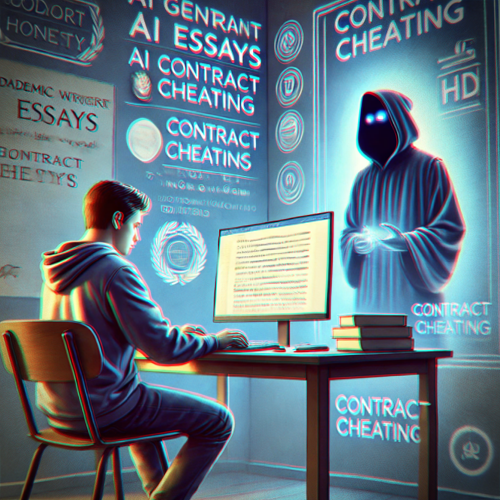
Tackling Academic Dishonesty: Contract Cheating in 2025

Contract cheating, the outsourcing of student work to a third party,  is a phenomenon which shows no signs of slowing down in 2025.  Recent AI developments have enabled many companies to personalise and expand their services, using AI to mimic students’ writing styles and create bespoke essays that can evade plagiarism detection tools.

These services often advertise themselves in vague and misleading ways, claiming to ‘help’ students with their academic work.  In reality, they offer complete essay-writing solutions and even tailored responses to assignments.

In this blog piece, Katherine Barnett considers the spread of these platforms, how they impact academic integrity, and what should be done to combat them.  Read the article in full here.

You can also hear more about contract cheating services and their advertising tactics in episode three of The VICTVS Podcast.

Effective Change Management in Assessment 

Change is inevitable for the operations of any organisation – including those in the assessment space – but effective change management is what allows these transitions to happen smoothly and successfully.

We have seen the consequences of poor change management in various news headlines over the years.  In 2020, the South Australian Certificate of Education (SACE) faced significant challenges during the implementation of online psychology exams, with technical issues causing disruption for nearly 3,000 students.  This led to widespread frustration among students, parents, and teachers, highlighting the need for robust technical infrastructure and proper testing before the rollout of digital exam platforms.

Poorly managed change in the assessment space can lead to exam delays or delays in results, decreased assessment quality, and even increased cheating and security risks.  These are issues that not only affect students, but also parents, teachers and regulatory bodies, and can cause major reputational damage.

In our latest blog piece, we explore the reasons change management often goes wrong, and share practical strategies to ensure success.  We also share how VICTVS helps organisations implement change effectively, avoiding the pitfalls and delivering better outcomes for all involved.

To read the full article, click here.

The VICTVS Podcast, ‘Revision Notes – December‘ – Available Now 

Back in December, our host Katherine Barnett sat down with global technology specialist and consultant Geoff Chapman to discuss some of our favourite news stories from 2024, as well as Geoff’s predictions for the coming year.

The conversation ranged from the rise in SEN requests to bizarre studies about exam ceiling height, with Geoff giving invaluable insight into the industry and outlining his wishes for the education space in 2025.

To watch the episode, check out the VICTVS podcast on YouTube, or listen via Spotify or Apple Podcasts.

Other News 

  • Takedown #27: Hail Mary Papers:  The contract cheating newsletter This Isn’t Fine spotted Hail Mary Papers, a contract cheating company, advertising on YouTube.  The ads feature images of the Virgin Mary alongside claims the company can save students from “plagiarism hell” and complete their schoolwork for them. 
  • This School Will Have Artificial Intelligence Teach Kids (With Some Human Help):  An online school is set to open in Arizona later this year which will (at least partly) replace teachers with AI.  Unbound Academy will prioritise AI in its content delivery model, with teachers becoming “guides” who will monitor students progress.  More on this at EdWeek
  • Should Instructors Ask Students to Show Document Histories to Guard Against AI Cheating?:  This piece from EdSurge explores process tracking as a means of monitoring for student’s use of AI in assessments.  While the method could show if students are copying and pasting from a tool like ChatGPT, some academics warn it violates student’s privacy. 
  • Third of Pupils Now Get Extra Time in Exams:  According to Ofqual, nearly 420,000 pupils in England are getting extra time in their GCSE and A-Level exams.  That’s almost a third of all pupils and four times higher than a decade ago.  The Times has the full story
  • The Best and Worst in Academic Integrity 2024:  In case you missed it, The Cheat Sheet produced their annual overview of the best and worst in academic integrity for 2024, featuring key stories of the year regarding Chegg, Grammarly and more.  Read the full issue here

Thanks for reading our newsletter.  Please subscribe using the form in the sidebar if you would like to receive future editions directly to your inbox.[us_separator size=”custom” height=”30px”][us_post_author link=”%7B%22type%22%3A%22author_page%22%7D” avatar=”1″][us_separator size=”small”][vc_column_text css=”%7B%22default%22%3A%7B%22font-size%22%3A%2220px%22%7D%7D”]    Share this article[/vc_column_text][us_sharing providers=”email,facebook,twitter,linkedin,vk,whatsapp” counters=”hide”]

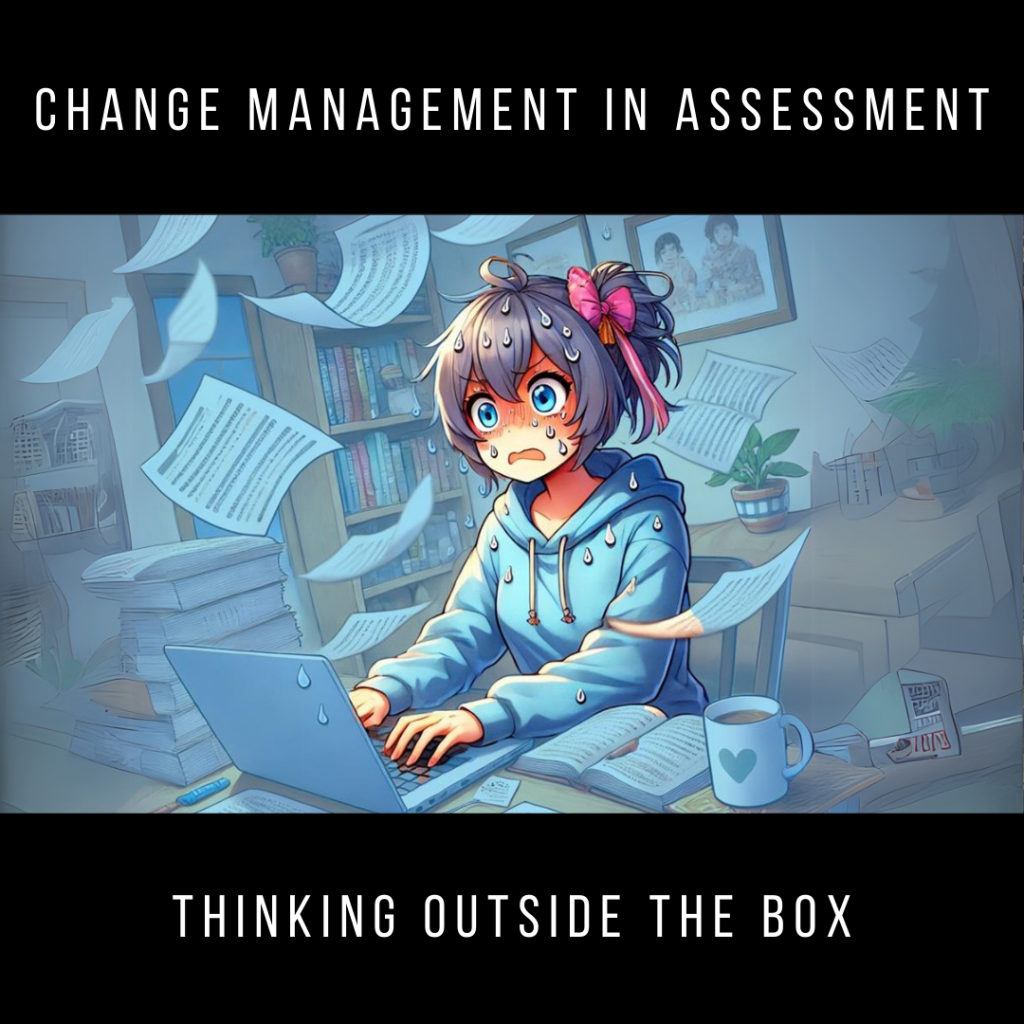
Change Management In Assessment – Thinking Outside the Box

Anime woman in a blue jacket looks stressed a laptop with papers flying around her.

Imagine a world where exam results are delayed – students, parents, schools, and regulatory bodies are all in chaos, with the blame landing squarely on the awarding body.  All because of poorly managed changes.

The real-life stakes of poor change implementation can be severe, with financial penalties, fines from watchdog organisations, and reputational damage just some of the associated risks, all resulting in sleepless nights for business leaders.  Last year, for instance, NCFE were fined £300,000 for failing to develop valid question papers for its healthcare, healthcare science, and science T-level papers in summer 2022.

We see the impacts of poor change management in every industry, even politics.  In the transition from a Tory to Labour government in the UK, Chancellor Rachel Reeves has faced criticism for her handling of the economy, resulting in rising borrowing costs and a depreciating pound.  In the U.S., Donald Trump’s re-election has resulted in confusion regarding policy implementation; his endorsement of a “one powerful bill” approach to his domestic policy agenda has left Senate Republicans uncertain about the legislative path forward, leading to confusion and strategic disputes within the party.

How do people get change management so wrong?

Change management can go wrong due to a variety of factors, with poor communication a key culprit.  In the context of assessments, inadequate communication between awarding bodies and candidates about exam changes can lead to confusion, fear, and even resentment.

One significant barrier to effective communication is fear of backlash.  An awarding body might avoid directly engaging with members or candidates about significant changes for fear of negative reactions, resulting in changes being relayed poorly.  Ironically, this can lead to even greater negative reactions when the changes inevitably go wrong.

Beyond communication issues, operational missteps are another common reason change management can go awry. Logistical challenges like insufficient preparation, a lack of robust technical support, or unclear processes can severely impact the successful rollout of changes, such as switching to a new assessment platform or re-scheduling a physical exam date.

What can happen when changes are mismanaged in assessment?

Unsuccessful change management in the assessment space can result in exam chaos and frustrated candidates, unable to take their exams or get the qualifications they have been working hard for.

An example of poor change management in education is the 2024 case involving the State Bar of California.  The California Supreme Court rejected the Bar’s proposal to implement a new exam due to procedural errors during the approval process.  This decision delayed the rollout of the updated exam, which was designed to replace the multijurisdictional test and save $3.8 million (USD) annually.  This setback underscores the importance of following proper procedures when implementing significant changes.

Ultimately, bad change management leads to emotional and financial tolls on organisations, leaders and end users.  The resulting bad press can also impact public perception of an organisation and result in loss of business – proving that ‘bad press’ really does exist.

What can be done to ensure successful change management?

Transparency regarding any changes should be communicated early, with rationale provided to ensure all those involved understand exactly why and how the changes are happening.  Messaging should be tailored for different audiences and there should be forums or help desks to receive and respond to feedback and questions.

Robust support systems are necessary to help with these responses.  This includes 24/7 technical support to help people during the transitional period, as well as solid internal training programs to equip internal teams with the tools they need to manage queries and resolve issues quickly.

At VICTVS, we have these systems in place to ensure that we can help awarding bodies successfully carry out any changes to an assessment.  Our teams are trained to act quickly and communicate clearly with all involved to ensure that all changes are not only passed on, but understood.  Our 24/7 support team and VICTVS Global Network are also on-hand to help candidates with any problems.

Thinking outside the box

By looking to change management practices in the wider world, VICTVS has been able to gain a broader, more multidimensional perspective that sets us apart from our competitors.  Drawing inspiration from successful examples in other industries, we embrace innovative approaches to implementing change.

The transition to electric vehicles (EVs) is a great example of change implementation on a global scale.  Governments worldwide have used financial incentives to encourage the transition to electric cars, such as subsidies and grants – for instance, the U.S. has federal tax credits (up to $7,500) for EV buyers.  Reduced taxes and free charging have also motivated more people to switch to electric.  Simultaneously, measures such as emission taxes and carbon penalties make traditional vehicles less attractive.

The increase in EV adoption stems from clear communication regarding these policies, effective operational execution, and increasing public awareness of environmental issues.  Together, these elements have created a sustained and growing shift toward electric vehicles.

Though we might not be working in the same industry, there are lessons to be had here.  By aligning well-communicated strategies with operational expertise, we can also ensure that any changes which have to be rolled out with our clients are carried out successfully.

Navigating change management with confidence

Change management is an integral part of any business, but it carries unique challenges in the education sector.  Missteps in this space can disrupt exam schedules, erode trust, and impact candidates’ futures.  By learning from successful change strategies in other industries, we can adopt approaches that combine clear communication, operational excellence, and stakeholder engagement.

At VICTVS, we recognize the importance of managing changes with precision and care.  While we are ready to support awarding bodies in navigating transitions effectively, the broader goal remains creating a culture where change is embraced confidently as an opportunity for growth and improvement.  With the right strategies in place, even the most complex transitions can be managed smoothly.

Tackling Academic Dishonesty: Contract Cheating in 2025

[vc_row][vc_column][vc_column_text]The concept of paying someone to do your homework is nothing new.  But over the last year, more and more contract cheating companies have sprung up, many becoming more brazen with their advertising.  These include essay mills, content generation and online exam help services.

The contract cheating and academic integrity newsletter ‘This Isn’t Fine’ spotted one such company, Haily Mary Papers, advertising on YouTube earlier this month.  Run by investigative journalists Joseph Thibault and Sam Silverman, ‘This Isn’t Fine’ is doing great work not only tracking the spread of these companies, but also managing their Essay Mill Database.  You can stay up to date with their work and access their database here.

The Hail Mary Papers’ static ads use imagery of the Virgin Mary alongside claims that the company can save students from ‘plagiarism hell’ and complete their schoolwork for them.

A screenshot of an ad for Hail Mary Papers featuring an AI generated image of the Virgin Mary in a red robe, biting a green apple. Underneath the ad reads 'Let Us Help' with claims to help students beat plagiarism.

Though this might be one of the more eye-catching ad campaigns, ‘This Isn’t Fine’ has been tracking other contract cheating ads for companies such as WriteMyPapers, Aithor and StudyStealth, who all advertise services to help students with their essays and exams.  Though these ads are rightly prohibited, the automation of ad review services means many slip through the cracks and target even those students merely searching for essay help and not a way to cheat.  A lot of these ads are also deliberately vague and deceptive about the reality of the services they offer, something we discussed with The Cheat Sheet author Derek Newton in episode three of The VICTVS Podcast.

While contract cheating services have become increasingly common, the recent rise in popularity of generative AI has helped fuel their growth, with many companies basing their entire service around the technology.  These companies offer a more student-focused alternative to ChatGPT, an app which itself has seen a mammoth 1,900% increase in search volume since January 2024, with 48% of students saying they use the tool.

A graph showing a steady uptake in searches for ChatGPT on Google between January 2024 and January 2025.

The aforementioned Aithor is one contract cheating company using AI, marketing itself as an “AI-powered writing assistant” that will, when prompted, generate an entire essay for a user.  This essay comes complete with referencing and personalisation options to mimic the user’s tone of voice; alarming to say the least.

So, why are students turning to these services?

While pressure to achieve is certainly one reason students use these services, I think it’s safe to say that their proliferation and the ease in which students can now access them is a key motivator in why so many are trying them out.  After all, the temptation of having to do less schoolwork can be too much for some to resist.

In a 2024 paper on cheating in exams, researchers cited an analysis of 5,000 tweets from students offering to pay for an essay.  While some students claimed they wanted to use a service because they were struggling to finish an assignment, others simply stated they had no interest in doing the work and wished to outsource it so that they could focus on “more pleasurable activities such as shopping and parties.”

Other reasons, such as lack of English proficiency and the need to spend more time at work instead of studying, were also given by students.

With more and more of these services becoming available to students…

What does this mean for academic integrity?

Contract cheating undeniably undermines the purpose of assessment.  Researchers’ now think that 8-9% of degrees in the UK are unreliable as a direct result of contract cheating.  This is a startling statistic and suggests that many people may be employed at a job they aren’t actually qualified for.

Needless to say this has major ethical implications, and in the case of industries like medicine, manufacturing or transportation, could put people’s lives at risk.

Ultimately, resorting to cheating services robs students of essential learning and can lead to potentially fatal skills gaps in professional settings.

Contract cheating in 2025

With AI services on the rise, it seems wise to assume more AI-based contract cheating services will appear in 2025, offering more sophisticated ways to cheat in assessments.  These tools will likely have options to personalise text to mimic a candidates writing style, further reducing their chance of detection.

To combat the rise of these companies and their use by students, institutions must adopt proactive measures, including AI detection, enhanced exam monitoring, and innovative assessment formats, to stay ahead of these challenges.  At the same time, global collaboration is necessary to establish regulations and take legal action against these companies, ensuring they are held accountable for exploiting students.

Platforms like Google Ads also need to get better at spotting ads submitted by these companies and prevent them from going live and targeting students in the first place.

If left unchecked, the rise of contract cheating services poses a serious threat to the integrity of academic institutions.  Only by taking a multi-faceted approach can we combat these services and ensure students earn their qualifications through honest effort and a commitment to genuine learning.[/vc_column_text][/vc_column][/vc_row]

The VICTVS Podcast: Revision Notes – December

[vc_row][vc_column][vc_column_text]From concerns about the digitalisation of exams to bizarre (and false) stories about exam ceiling height, 2024 has had its fair share of contentious, interesting and downright weird news stories in the education and assessment space.

With 2025 on the horizon, our host Katherine Barnett sat down with global technology specialist and consultant Geoff Chapman for a special edition of Revision Notes, where we look back at these stories from the past year.  We also discuss the increase in SEN requests and the rising demands to meet every student’s needs, as well as one invigilator’s claim to have only spotted three cheats in 25 years.  Finally, we look at Geoff’s predictions for 2025, as well as what he would like to see happening next in the education and assessment space.

You can watch the episode on YouTube via the link below, or listen on Spotify or Apple Podcasts.

Interested in Geoff’s work? You can visit his website here, and keep up to date with him via Bluesky, Twitter and LinkedIn.[/vc_column_text][us_html]JTNDaWZyYW1lJTIwd2lkdGglM0QlMjIxMDAlMjUlMjIlMjBoZWlnaHQlM0QlMjIzMTUlMjIlMjBzcmMlM0QlMjJodHRwcyUzQSUyRiUyRnd3dy55b3V0dWJlLW5vY29va2llLmNvbSUyRmVtYmVkJTJGQmFHd0U0Q0ZuaHMlM0ZzaSUzRDhMSVlIc3A2OHZ3Q0d6RXklMjIlMjB0aXRsZSUzRCUyMllvdVR1YmUlMjB2aWRlbyUyMHBsYXllciUyMiUyMGZyYW1lYm9yZGVyJTNEJTIyMCUyMiUyMGFsbG93JTNEJTIyYWNjZWxlcm9tZXRlciUzQiUyMGF1dG9wbGF5JTNCJTIwY2xpcGJvYXJkLXdyaXRlJTNCJTIwZW5jcnlwdGVkLW1lZGlhJTNCJTIwZ3lyb3Njb3BlJTNCJTIwcGljdHVyZS1pbi1waWN0dXJlJTNCJTIwd2ViLXNoYXJlJTIyJTIwcmVmZXJyZXJwb2xpY3klM0QlMjJzdHJpY3Qtb3JpZ2luLXdoZW4tY3Jvc3Mtb3JpZ2luJTIyJTIwYWxsb3dmdWxsc2NyZWVuJTNFJTNDJTJGaWZyYW1lJTNF[/us_html][vc_column_text]About The VICTVS Podcast

Learning goes beyond exams and qualifications—it’s about expanding horizons, overcoming challenges, and building skills and knowledge.  At VICTVS, we invite guests from a variety of industries and cultures to share their insights, offering lessons from their diverse experiences. If you’re passionate about education and how learning can help you achieve your goals, the VICTVS podcast is for you.

Enjoy our content?  Subscribe, rate, and share The VICTVS Podcast on Apple Podcasts, Spotify, and YouTube.  A full episode transcript is also available here.[/vc_column_text][/vc_column][/vc_row]

Just because they’re free, doesn’t mean they’re safe. AI at FAB 2024

The VICTVS stand at the FAB 2024 conference and event, featuring a black banner and black fronted coffee bar.

[vc_row][vc_column][vc_column_text css=”%7B%22default%22%3A%7B%22margin-bottom%22%3A%2220px%22%2C%22padding-bottom%22%3A%2220px%22%7D%7D”]Despite last week’s weather, VICTVS made it to the Federation of Awarding Bodies 2024 Conference, Exhibition, and Awards ceremony.  Hosted in Leicester, the annual FAB conference is a must-attend event for many awarding organisations, ed-tech companies, assessment services, and anyone with an interest in the education industry.

As longstanding attendees of FAB, we returned this year to host a coffee bar, with our team ready to assist attendees with any queries about our services.  While the team manned our stand, I had the chance to explore the conference as an attendee and join several engaging panel discussions and talks.

The conference opened with speeches and panel discussions featuring Jane Belfourd, Director for Technical Education at the Department for Education, alongside representatives from SIAS, JISC, Ofqual, and more.  Two panels followed: one on the future of UK skills and further education, and the other on AI and assessment.  This session highlighted both the opportunities AI presents and the challenges it poses in assessments and awarding.

With generative AI dominating public discourse, this was just one of many AI-related talks at FAB.  The panel explored how AI can enhance a learner’s experience—for example, by helping those whose first language is not English improve their pronunciation and grammar.  One speaker also suggested that schools should teach students how to create effective AI chatbot prompts, as this is quickly becoming a vital workplace skill.

As I have a background in digital rights and cybersecurity, I couldn’t help but approach the discussions from this perspective.  Debra Grey, Principal and CEO of Hull College, raised an important point about schools using free AI tools to save money, warning: “Just because they’re free, doesn’t mean they’re safe.”

While the panel quickly moved on from this point, I was left wanting a deeper examination of this issue—particularly considering the amount of research that has gone into unsafe, free apps being used in schools.

In 2022, Human Rights Watch investigated over 150 educational apps, most of them free, and found that 89% monitored or had the ability to monitor their users.  Additionally, more than 140 of the companies examined gave direct access to user data or sold it to 196 different advertising companies.

Just last year, it was revealed that 96% of free apps used or recommended for use by K-12 students in America shared students’ personal information with third parties.

So it’s clear that there’s already a problem with dubious apps being used in schools.  With the rise of AI and the growing number of AI-powered apps, it seems likely that many schools may unknowingly recommend even more apps with questionable data-sharing practices.

Given the density of this topic, I was disappointed that it wasn’t further discussed, along with broader dialogue on student safety, data protection, accessibility, and generative AI’s inherent fallibility.

Later in the day, I attended two other talks: ‘The Future of Assessment – Towards a Vision for Tech-Enabled Assessment’ and ‘Navigating Assessment Integrity in the Age of Generative AI.’  Both sparked meaningful discussions, particularly around ideas for potential apps and technology that could be used in the classroom.  The second talk, led by a Turnitin representative, highlighted the challenges of detecting AI in coursework and raised important questions about how assessment formats must evolve and adapt to students’ evolving use of technology.

This theme ran throughout much of FAB: How can assessments keep pace with rapidly changing technology?  And how should students be encouraged to use these tools in formal assessments?

AI and technology dominated the days conversations, and I found the panels both insightful and thought-provoking.  I particularly enjoyed the opening discussions and the chance to speak with other attendees, who were clearly passionate about the future of education and how best to support learners of all ages.

That said, I felt there was much missing from the conversation—particularly around cybersecurity, data privacy and the risks of integrating emerging technologies into underprepared schools.  Moreover, while everyone acknowledged AI’s potential, I wish there had been more focus on its flaws, such as its bias and tendency for inaccuracies.  This technology is far from perfect, and failing to acknowledge its limitations does nothing to help us.  Rather than discouraging its use, students should be taught how to harness generative AI effectively while critically assessing its outputs.

In the future, it would be helpful to invite AI and technology experts from outside the education sector to speak on these issues.  By doing so, we can gain a better understanding of emerging technologies and how to integrate them into assessments and the classroom in a genuinely helpful and safe manner.

I only attended the Monday of FAB, but I found the day both thought-provoking and inspiring—not just because of what was discussed, but because of what was left unsaid.  It will be interesting to see how education evolves between now and FAB 2025.  Hopefully, by then, we’ll have answers to many of the questions raised at this year’s event.[/vc_column_text][us_separator size=”custom” height=”30px”][us_post_author link=”%7B%22type%22%3A%22author_page%22%7D” avatar=”1″][us_separator size=”small”][vc_column_text css=”%7B%22default%22%3A%7B%22font-size%22%3A%2220px%22%7D%7D”]    Share this article[/vc_column_text][us_sharing providers=”email,facebook,twitter,linkedin,vk,whatsapp” counters=”hide”][/vc_column][/vc_row]

The VICTVS Podcast: Episode 9 – Investigating Modern Slavery: From Awareness to Action

[vc_row][vc_column][vc_column_text css=”%7B%22default%22%3A%7B%22margin-bottom%22%3A%2220px%22%2C%22padding-bottom%22%3A%2220px%22%7D%7D”]

According to the Global Slavery Index, a shocking 50 million people are currently living in modern day slavery worldwide, with 10 million of those being children.  The reasons for this are numerous, with the Global Slavery Index citing complex conflicts, widespread environmental degradation and the economic and social impact of Covid 19 as just some contributing factors.

In this edition of The VICTVS Podcast, we discuss this complex and challenging issue with help from our expert guests Lucy Mann and Marija Jovanovic.  As today is the International Day for the Abolition of Slavery, there’s no better time to discuss this topic and educate ourselves on what exactly modern day slavery is, how we can spot it and what should be done to prevent it.

We discuss the difficulty of defining modern slavery and the many subtle forms it can take,  talking through real life incidents our guests have come across throughout their work.  From here, we examine how to identify modern slavery as it happens, as well as what governments should be doing to prevent it.  Finally, Marija outlines her research on the imprisonment of modern slavery survivors, highlighting how more survivors of modern slavery are in prison than traffickers.

In her work with the British charity Unseen, Lucy Mann helps businesses monitor for and prevent modern day slavery and worker exploitation.  Unseen also runs the UK’s modern day slavery and exploitation helpline, where survivors can seek support and get advice.

Our second guest, Marija Jovanovic, is a lawyer and researcher at the Bonavero Institute of Human Rights. She is also a co-investigator at Modern Slavery and Human Rights Policy and Evidence Centre (PEC), producing research that aims to enhance people’s understanding of modern slavery and transform the effectiveness of law and policies designed to address it.

Should you or someone you know suspect they are experiencing modern day slavery, Unseen’s national helpline service is available here.

VICTVS Assured works to provide Ground Truth Reporting to clients around the world. We help our clients achieve ESG compliance, which includes spotting and stopping modern day slavery. Visit us here to find out more.

[/vc_column_text][us_html]JTNDaWZyYW1lJTIwd2lkdGglM0QlMjIxMDAlMjUlMjIlMjBoZWlnaHQlM0QlMjIzMTUlMjIlMjBzcmMlM0QlMjJodHRwcyUzQSUyRiUyRnd3dy55b3V0dWJlLW5vY29va2llLmNvbSUyRmVtYmVkJTJGZHZBNjZoam1qZjglM0ZzaSUzRDg2MW90UzVENG5LTng2NHAlMjIlMjB0aXRsZSUzRCUyMllvdVR1YmUlMjB2aWRlbyUyMHBsYXllciUyMiUyMGZyYW1lYm9yZGVyJTNEJTIyMCUyMiUyMGFsbG93JTNEJTIyYWNjZWxlcm9tZXRlciUzQiUyMGF1dG9wbGF5JTNCJTIwY2xpcGJvYXJkLXdyaXRlJTNCJTIwZW5jcnlwdGVkLW1lZGlhJTNCJTIwZ3lyb3Njb3BlJTNCJTIwcGljdHVyZS1pbi1waWN0dXJlJTNCJTIwd2ViLXNoYXJlJTIyJTIwcmVmZXJyZXJwb2xpY3klM0QlMjJzdHJpY3Qtb3JpZ2luLXdoZW4tY3Jvc3Mtb3JpZ2luJTIyJTIwYWxsb3dmdWxsc2NyZWVuJTNFJTNDJTJGaWZyYW1lJTNF[/us_html][vc_column_text css=”%7B%22default%22%3A%7B%22margin-bottom%22%3A%2220px%22%2C%22padding-bottom%22%3A%2220px%22%7D%7D”]

About The VICTVS Podcast

Learning is not just about exams and qualifications. It’s about exploring new horizons, overcoming challenges, and developing our skillsets and knowledge as individuals and as members of the global community. At VICTVS, we invite guests from diverse backgrounds and fields to appear on our podcast, to share their stories and insights.  We also chat with our friends and colleagues from different cultures and backgrounds, and experts from various industries and sectors, to seek out valuable lessons from their experiences and perspectives.  If you are interested in how education and learning can help you achieve your goals, and in hearing about how people who share our values of honesty, integrity, professionalism, and courage have achieved incredible things, then the VICTVS podcast is for you.

If you enjoy our content and would like to support us, please subscribe, review and rate The VICTVS Podcast on Apple Podcasts, Spotify, and , YouTube Music as well as sharing with anyone who you think might enjoy the listen.

You can also find a full transcript of the episode here.

[/vc_column_text][us_separator size=”custom” height=”30px”][vc_column_text css=”%7B%22default%22%3A%7B%22font-size%22%3A%2220px%22%7D%7D”]    Share this article[/vc_column_text][us_sharing providers=”email,facebook,twitter,linkedin,vk,whatsapp” counters=”hide”][/vc_column][/vc_row][vc_row][vc_column][/vc_column][/vc_row]

The VICTVS Podcast: Revision Notes

[vc_row][vc_column][vc_column_text css=”%7B%22default%22%3A%7B%22margin-bottom%22%3A%2220px%22%2C%22padding-bottom%22%3A%2220px%22%7D%7D”]Introducing a new shorter edition of The VICTVS podcast, Revision Notes.  In this series, we’ll dive into the latest news from the assessment sector, as well as developments in ed tech and AI’s influence on the education space. 

Join our hosts, Xanthe Mitten and Katherine Barnett, as they debate the pros and cons of digital exams, a recent experiment using AI detection software and a new driving test limit in Bulgaria, as well as other news.  

You can watch the episode on YouTube via the link below, or listen on Spotify or Apple Podcasts.  

[/vc_column_text][us_html]JTNDaWZyYW1lJTIwd2lkdGglM0QlMjIxMDAlMjUlMjIlMjBoZWlnaHQlM0QlMjIzMTUlMjIlMjBzcmMlM0QlMjJodHRwcyUzQSUyRiUyRnd3dy55b3V0dWJlLW5vY29va2llLmNvbSUyRmVtYmVkJTJGY05MQm5FX3ZhcmclM0ZzaSUzREl4d0RXRG1UNWRja0c2emwlM0ZyZWwlM0QwJTIyJTIwdGl0bGUlM0QlMjJZb3VUdWJlJTIwdmlkZW8lMjBwbGF5ZXIlMjIlMjBmcmFtZWJvcmRlciUzRCUyMjAlMjIlMjBhbGxvdyUzRCUyMmFjY2VsZXJvbWV0ZXIlM0IlMjBhdXRvcGxheSUzQiUyMGNsaXBib2FyZC13cml0ZSUzQiUyMGVuY3J5cHRlZC1tZWRpYSUzQiUyMGd5cm9zY29wZSUzQiUyMHBpY3R1cmUtaW4tcGljdHVyZSUzQiUyMHdlYi1zaGFyZSUyMiUyMHJlZmVycmVycG9saWN5JTNEJTIyc3RyaWN0LW9yaWdpbi13aGVuLWNyb3NzLW9yaWdpbiUyMiUyMGFsbG93ZnVsbHNjcmVlbiUzRSUzQyUyRmlmcmFtZSUzRQ==[/us_html][vc_column_text css=”%7B%22default%22%3A%7B%22margin-bottom%22%3A%2220px%22%2C%22padding-bottom%22%3A%2220px%22%7D%7D”]

About The VICTVS Podcast

Learning is not just about exams and qualifications. It’s about exploring new horizons, overcoming challenges, and developing our skillsets and knowledge as individuals and as members of the global community. At VICTVS, we invite guests from diverse backgrounds and fields to appear on our podcast, to share their stories and insights.  We also chat with our friends and colleagues from different cultures and backgrounds, and experts from various industries and sectors, to seek out valuable lessons from their experiences and perspectives.  If you are interested in how education and learning can help you achieve your goals, and in hearing about how people who share our values of honesty, integrity, professionalism, and courage have achieved incredible things, then the VICTVS podcast is for you.

If you enjoy our content and would like to support us, please subscribe, review and rate The VICTVS Podcast on Apple Podcasts, Spotify, and , YouTube Music as well as sharing with anyone who you think might enjoy the listen.

You can also find a full transcript of the episode here.[/vc_column_text][us_separator size=”custom” height=”30px”][vc_column_text css=”%7B%22default%22%3A%7B%22font-size%22%3A%2220px%22%7D%7D”]    Share this article[/vc_column_text][us_sharing providers=”email,facebook,twitter,linkedin,vk,whatsapp” counters=”hide”][/vc_column][/vc_row][vc_row][vc_column][/vc_column][/vc_row]

End-to-End vs Unified Assessment. Understanding the difference.

[vc_row][vc_column][vc_column_text css=”%7B%22default%22%3A%7B%22margin-bottom%22%3A%2220px%22%2C%22padding-bottom%22%3A%2220px%22%7D%7D”]The terms End-to-End E-Assessment services and Unified Assessment Solution may seem similar, but they reflect two very different approaches to the organisation and delivery of assessment programmes.  We have written this short article to help you gain a better understanding of how each option might benefit you and your organisation – with a particular focus on global assessment programmes.

To begin, here is a breakdown of the key differences between the two.


An ‘End-to-End e-assessment service’ refers to a comprehensive, linear process that covers all stages of digital assessment design and delivery.  It ensures that every step of the assessment lifecycle is managed, from the creation of the exam and population of item banks through to the delivery of questions to candidates, scoring, and the final reporting of results.  This type of service is particularly focused on streamlining and automating each phase of the assessment in a linear fashion, ensuring a seamless experience for the candidate across the different stages of their journey.

Key features of an End-to-End e-assessment service include:

  • Complete Lifecycle Management: An end-to-end e-assessment service encompasses all stages, including exam creation, candidate registration, delivery (in physical test centres or online), proctoring, grading, and results analysis.
  • Automation and Integration: Each stage is typically connected through integrated systems, ensuring that data flows smoothly between steps (e.g., automatic transfer of candidate data from registration to proctoring systems).
  • Customisation: Individual phases within the end-to-end process can often be customised according to the exam owner’s requirements, for example using different question types, setting specific rules, or integrating with existing Learning Management Systems (LMS).
  • Flexibility in Delivery Methods: This type of service may allow for various delivery modalities, such as remote online testing, in-person testing at centres, or hybrid models.
  • Post-assessment Analytics: End-to-end e-assessment services generally include robust post-exam analytics and reporting tools to help assess exam performance, identify patterns, and improve future assessments.

For example, a company specialising in e-assessment might provide an all-inclusive software platform where clients can design their exams, set up proctoring services, deliver exams to candidates, and receive results, all through a single service.  Alternatively, a service provider may offer to take control of the entire assessment process, right from the initial design phase and question authoring, right through to delivery and ultimately reporting back results to the exam owner.


A Unified Assessment Solution, on the other hand, focuses on offering a centralised platform that consolidates all types of assessments, tools, and related services into one single system.  It not only covers the delivery of assessments (similar to an end-to-end solution), but also integrates numerous types of assessments, across different platforms and formats, into one cohesive, interoperable system.  A unified solution typically emphasises consistency and integration across multiple assessment needs, across different disciplines or departments.

Key Features of a Unified Assessment Solution include:

  • Centralised Platform: The core function of a Unified Assessment Solution is that all assessments—whether summative, formative, diagnostic, or adaptive—are managed within a single, unified platform.  This includes authoring, delivery, and reporting, as well as integration with other educational or corporate systems.
  • Holistic Integration: A Unified Assessment Solution integrates various tools and services such as learning management systems (LMS), credentialing systems, AI analytics, content libraries, and remote proctoring capabilities to provide a one-stop solution for all assessment needs.
  • Standardisation Across Assessments: By utilising a Unified Assessment Solution, assessments can be standardised in terms of format, rules, invigilation standards, and results reporting.  This is beneficial when managing multiple exams across countries, regions, departments, subjects, or institutions, as increased consistency leads to an increase in the integrity of the assessments.
  • Data Consistency: A Unified Assessment Solution often prioritises the consistency of data collection and analytics, providing a deeper view of candidate performance across different assessments as seen over time, improving long-term decision-making by exam owners and delivery partners.
  • Scalability and Adaptability: Unified systems tend to be more scalable, allowing organisations to manage large volumes of assessments from various departments or regions and easily expand as needs grow.  They often support diverse forms of assessments (from simple multiple-choice exams to complex simulations) from within the same platform.

Universities or large organisations with many different departments (e.g., business, engineering, humanities) might implement a Unified Assessment Solution to handle all departmental exams through a common system, ensuring that each department’s exams follow the same standards and utilise shared resources, while still being tailored to specific needs and providing much greater depth of data analysis in comparison to alternatives.

Some of the key differences between the two types of solution are outlined below.

Scope of Integration

  • End-to-End E-Assessment Service: Focuses on covering all stages of a specific exam’s lifecycle (from creation to results), but each exam may function independently.
  • Unified Assessment Solution: Brings together various types of assessments into a single platform, integrating them with other systems and offering a standardised approach to assessment across multiple disciplines or departments.

Customisation vs. Standardisation

  • End-to-End E-Assessment Service: Typically allows for customisation per exam or assessment lifecycle, tailored to the specific needs of individual exams.
  • Unified Assessment Solution: Aims for standardisation across various assessments and systems, while still offering adaptability for different subjects or departments and customisation of the user interface.

Integration of Multiple Assessment Types

  • End-to-End E-Assessment Service: Generally focused on one type of assessment or assessment format at a time.
  • Unified Assessment Solution: Supports multiple types of assessments (e.g., summative, formative, diagnostic) and integrates these different formats into a singular, cohesive system.

Flexibility in Tools

  • End-to-End E-Assessment Service: May provide its own tools for proctoring, grading, etc., but often tailored for each individual exam.
  • Unified Assessment Solution: Integrated tools including remote proctoring and AI offer a more comprehensive solution, providing a ‘unified’ experience for all stakeholders.

In short, an end-to-end e-assessment service is a process-focused system that handles the full lifecycle of individual exams, whereas a Unified Assessment Solution is a platform-focused system designed to centralise and standardise multiple types of assessments across an organisation or institution.  Both approaches can provide comprehensive solutions but differ in the breadth and focus of their offerings.

How to choose what is right for you.

Choosing between an end-to-end e-assessment service and a Unified Assessment Solution must be informed by the specific needs of the organisation or institution, and the complexity of its assessment requirements. Each option has strengths in different areas, so the best choice depends on the context in which it will be used.  Here are some considerations to help determine which might be the best fit.

When an End-to-End E-Assessment Service is the Best Choice:

  • Single, Focused Assessment Needs: If your organisation primarily conducts one type of assessment (e.g., certification exams or professional competency tests), and you need a streamlined, well-defined process from exam creation to results, an end-to-end e-assessment service is potentially the best fit.
  • Customisable Workflow: If you need a highly customisable exam process, where each assessment may have its own specific format, rules, and proctoring needs, the linear approach of an end-to-end service could be beneficial.
  • Simplified Management of Individual Assessments: For organisations that run distinct exams or assessments with independent workflows, such as licensure exams, the end-to-end model ensures that each exam is managed efficiently and securely from start to finish.
  • Smaller Scale Needs: If the organisation is small or runs a limited number of assessments, an end-to-end service can provide everything needed without the complexity of a unified system.

When a Unified Assessment Solution is the Best Choice:

  • Multiple Assessment Types Across Departments or Subjects: If your organisation manages a wide range of assessments (e.g., formative, summative, diagnostic) across multiple subjects or departments, a unified solution is best for ensuring consistency and integration across all of them.
  • Standardisation and Centralisation: If the goal is to standardise the assessment process across various departments, programmes, or regions, a unified assessment solution ensures that all exams follow the same protocols and formats while integrating with other systems like learning management systems (LMS) or HR platforms.
  • Scalability: A unified solution is ideal for organisations or institutions with large-scale assessment needs.  It can handle thousands of exams from different sources and scales easily as needs grow.
  • Comprehensive Data Insights: If you require detailed, cross-assessment data analytics to track candidate performance across different subjects or over time, a unified platform offers more powerful and centralised data management.
  • Integration with Existing Systems: For organisations that already have other platforms in place (LMS, credentialing systems, etc.), a unified solution allows for smooth integration, ensuring that all systems work together seamlessly.

Which Option is the Best?

  • Best for Simplicity and Customisation (Smaller Scale): An end-to-end e-assessment service is the best if your primary goal is to streamline the lifecycle of specific exams with a strong focus on customisation. It’s especially suitable for organisations that need to handle fewer assessments but with high precision and tailored processes.
  • Best for Large-Scale, Integrated, and Standardised Needs: A Unified Assessment Solution is the best choice if your organisation needs a centralised system to handle a wide variety of assessments across multiple departments or locations.  It excels in environments that prioritise standardisation, scalability, outstanding security, and comprehensive integration with other platforms.

Our Recommendation

If you are a university, large institution, or corporation that needs to manage assessments across different subjects or regions and requires data to flow seamlessly across systems, the Unified Assessment Solution is likely the better long-term investment.

If your organisation focuses on single or niche exams, like a certification provider or professional body with very specific testing requirements, an end-to-end e-assessment service will likely offer more focused customisation and control for each exam.

Whichever option you think might be the best for you, at VICTVS we are happy to discuss the different approaches to help you find the best fit.  If you have enjoyed reading this article, please subscribe to our monthly newsletter or leave a comment below.[/vc_column_text][us_separator size=”custom” height=”30px”][us_post_author link=”%7B%22type%22%3A%22author_page%22%7D” avatar=”1″][us_separator size=”small”][vc_column_text css=”%7B%22default%22%3A%7B%22font-size%22%3A%2220px%22%7D%7D”]    Share this article[/vc_column_text][us_sharing providers=”email,facebook,twitter,linkedin,vk,whatsapp” counters=”hide”][/vc_column][/vc_row]

The Most Secure Exam. Part 1 – Supervigilators

[vc_row][vc_column][vc_column_text css=”%7B%22default%22%3A%7B%22margin-bottom%22%3A%2220px%22%2C%22padding-bottom%22%3A%2220px%22%7D%7D”]The question of how exams and assessments can be made as secure as possible – but that are still accessible to a diverse audience of candidates, is always at the forefront of the minds of those who work in assessment and awarding.  But this is not an easy question to answer.  For every effort that is made to increase security, an equal and opposing effort is made to undermine or counteract this by people who are looking to gain an unfair advantage.

From blunt force hacks including writing notes on your trousers, to the more sophisticated use of screen sharing apps and hidden earpieces, it is important never to underestimate the relentless nature of the phenomenon of cheating; complacency on our part only serves to open up the gaps in defences that are required for exploitation.

So how do we do it at VICTVS?  In this first article in a series on exam security, we examine one aspect of our approach to exam delivery that is both unique within our industry and is extremely effective.  We call this, Supervigilation!

In a world where…

In the realm of examination invigilation services, ensuring the integrity and security of assessments is paramount.  With the increase in use of remote invigilation and the steadily evolving landscape of digital assessments, the need for robust quality assurance measures is a critical aspect of high-stakes exam delivery. VICTVS understands this imperative and has devised a pioneering approach that combines human oversight with advanced technical solutions to deliver a new level of exam security that sets a new industry standard.  At the heart of this approach lies the role of Supervigilators, –  ‘Supervisor-Invigilators,’ who play a pivotal role in maintaining the highest standards of exam integrity.

Supervigilators serve as the guardians of exam integrity, entrusted with the responsibility of actively monitoring VICTVS’ main invigilation workforce.  They are the protectors of the protectors and the additional shield around the force.  Unlike our principal invigilators who oversee exam sessions directly, Supervigilators operate at a higher level, conducting quality assurance monitoring to ensure that our main invigilator workforce adheres to our rigorous standards, exam procedures and protocols.  Their role extends beyond mere observation; they are the frontline defenders against any potential breaches or irregularities in the invigilation process.

Resisting coercion and bribery

One of the risks associated with delivery of high-stakes exams in a venue – particularly if these exams are regularly delivered and staffed by the same people, is the risk of coercion, collusion or bribery in which a candidate or group of candidates attempt to gain an advantage by co-opting invigilators and exam staff with bribes or threats.  This is often cited by providers of remote proctoring services, as a reason why ‘AI’ powered remote proctoring is a superior offer – remove the human, remove the risk…  However with exams and assessments tending to be complex affairs that often result in stressful experiences for the candidates, we find that human invigilation done well, provides a welcome and supportive customer service to the candidates that cannot be overlooked.  Consequently, the use of Supervigilators as an additional layer of overwatch on the invigilators working in an exam environment, in addition with all of our technical tools for preventing exam malpractice, allows us to not only police the police, but also to provide helpful additional duty of care monitoring to both the invigilators on site, and to candidates all over the world.

Complementing AI

What sets Supervigilators apart is their ability to complement and enhance VICTVS’ technical exam security measures.  While advanced technologies such as biometric authentication and AI-powered proctoring software play an important role in detecting and deterring cheating, they are not foolproof.  Human oversight remains indispensable in identifying nuances and irregularities that may elude automated systems.  After all, current generations of AI tools are only prediction machines – they do not have genuine understanding of what they are observing.  Supervigilators bridge this gap by combining their expertise with technological solutions, and human intuition, creating a comprehensive security framework that leaves no room for compromise.

Continual improvement in exam delivery

Beyond their surveillance duties, Supervigilators also play a pivotal role in continuous improvement initiatives within VICTVS.  By providing valuable feedback and insights based on their monitoring activities, they contribute to the refinement of invigilation processes and the implementation of preventive measures to mitigate risks. Their proactive approach to quality assurance not only strengthens the resilience of VICTVS’ exam security framework but also fosters a culture of excellence and accountability within the organization.

Having created the role of Supervigilators, we have demonstrated that by leveraging human expertise alongside advanced technological solutions, VICTVS has established a multi-layered security framework that sets the gold standard for exam integrity.  Through their vigilance, professionalism, and dedication to excellence, our Supervigilators uphold the highest standards of integrity and ensure that every exam administered under the auspices of VICTVS is fair, transparent, and secure.[/vc_column_text][us_separator size=”custom” height=”30px”][us_post_author link=”%7B%22type%22%3A%22author_page%22%7D” avatar=”1″][us_separator size=”small”][vc_column_text css=”%7B%22default%22%3A%7B%22font-size%22%3A%2220px%22%7D%7D”]    Share this article[/vc_column_text][us_sharing providers=”email,facebook,twitter,linkedin,vk,whatsapp” counters=”hide”][/vc_column][/vc_row]