The VICTVS Podcast: Revision Notes – Exam Hack Special

[vc_row][vc_column][vc_column_text] It’s April and our hosts, Katherine Barnett and Xanthe Mitten, return for another special edition of Revision Notes.  In this episode, they dive into the latest exam cheating scandals shaking up the industry and shine a spotlight on an exciting event we are hosting this summer: the VICTVS Exam Hack 2025.

We begin with a look at the growing threat of contract cheating companies, followed by a startling report that cheating using AI has increased fifteenfold at UK universities.  The conversation then turns to the rise of TikTok influencers sharing cheating hacks, and the recent decision to ban AI chatbots in UAE schools.

In the final segment, we take a deep dive into the VICTVS Exam Hack – a one-of-a-kind event where we ask participants to beat our remote exam software and cheat in an online exam.  The goal?  To help us strengthen our systems and stay ahead of emerging cheating tactics.

And finally, Katherine and Xanthe have fun imagining the strategies they would use in the Exam Hack, if only they were allowed to take part.

Watch the full episode via YouTube at the link below, or listen on Spotify or Apple Podcasts. You can also get involved in the discussion using the comments section below or on YouTube.


About The VICTVS Podcast

Learning goes beyond exams and qualifications—it’s about expanding horizons, overcoming challenges, and building skills and knowledge.  At VICTVS, we invite guests from a variety of industries and cultures to share their insights, offering lessons from their diverse experiences. If you’re passionate about education and how learning can help you achieve your goals, the VICTVS podcast is for you.

Enjoy our content?  Subscribe, rate, and share The VICTVS Podcast on Apple Podcasts, Spotify, and YouTube.  A full episode transcript is also available here.[/vc_column_text][/vc_column][/vc_row]

VICTVS Newsletter April 2025

Yellow tinged sketch illustration of a man sat at a desk at a Mac laptop with his face blurred out, his ID next to him on the table.

The Challenges of Verifying Candidates’ Identities in Test Centres

Successfully setting up and running exams worldwide presents many challenges, but it is often the less obvious tasks that cause the biggest headaches.  One of these is candidate ID verification.  Whilst on the surface, this should be straightforward, differences in regional documentation, spellings of names, document fraud,  and varying exam procedures can create additional difficulties and disrupt the process.

If you are reading this newsletter, you are likely already aware of how prevalent academic cheating is in India – a region where a limited number of jobs has led to a hyper-competitive job market.  In one memorable case of impersonation (proxy candidacy) reported last year, a man in Kotkapura dressed up as his girlfriend and brought two fake ID documents to an exam, attempting to sit the test for her.  This example demonstrates how far some people are willing to go to get good grades, and why ID verification procedures are so important.

In our latest blog post, we explore the real-world challenges of verifying candidate identities, the risks of fraud and malpractice, and how exam procedures can unintentionally complicate the process.   Whilst there is no simple solution to this problem, the simple answer is that a multi-layered approach is critical.  Read more here and let us know your thoughts in the comment section. 

The VICTVS Blog – Honesty

At VICTVS, our core values – Honesty, Integrity, Professionalism, and Courage – are the foundation of everything we do.  These principles guide our work and are embedded in every employee and VICTVS Global Network member from day one.

Each quarter, we are spotlighting one of these values to explore its significance, and in Q1, our focus was on Honesty.

Fair assessments depend on invigilators and exam teams being vigilant, honest, transparent, and committed to reporting malpractice.  The integrity of our VICTVS Global Network members ensures we gain a clear and accurate understanding of what happens during an exam, allowing us to identify cheating attempts and provide reliable reports to our clients.  This commitment to honesty safeguards fairness in the exam process and upholds the credibility of assessments worldwide.

You can read more about what honesty means to us here

Agree with Joy?  Get involved in the conversation by leaving your thoughts in the comment section. 

The VICTVS Podcast, Revision Notes: Exam Hacking Special – Coming Soon

In our upcoming special edition of ‘The VICTVS Podcast – Revision Notes’, we discuss some of the latest and most interesting cases of cheating in exams and assessments.  Plus, we break down the VICTVS Exam Hack 2025, covering the rules of the game and the cheating tactics our hosts would try if they were allowed to compete.

To be the first to see this episode, subscribe to our YouTubeSpotify or Apple Music

Other News 

  • Assessment Security Research Group (ASRG) First Report of 2025:  This month (April), ASRG will publish its first short-form whitepaper of 2025.  Titled ‘State of the Nation:  Assessment Security at the Start of 2025’, this paper outlines current trends affecting secure exam delivery all over the world.  To find out more about ASRG, and to join as an individual or institutional member, please visit the website at www.assessmentsecurity.com
  • British Council Accused of Forcing Gig Economy Teachers Into ‘Feeding Frenzy’ For Work: ​ The British Council faces criticism for allegedly exploiting agency teachers on zero-hour contracts, forcing them into a competitive scramble for teaching assignments each week.  This comes after the CEO of the organisation stated that the British Council is “insolvent” without continuing access to UK a tax-payer funded loan.  Worthy of note are the British Council’s latest financial reports that show a 6-year contract with TCS Japan for the delivery of 240k examinations.  Surely a very lucrative and entirely commercial contract.
  • Why Are So Many Oxford Students Told They Have ADHD?: This piece by the Spectator pays a closer look at ADHD testing at Oxford.  With 98% of those who take the test being diagnosed and granted extra time in exams, it raises important questions about inequality in access to diagnoses and accommodations. 
  • There’s a Good Chance Your Kid Uses AI To Cheat:  While its supporters claim generative AI can enhance students’ learning experiences, this article highlights the growing use of tools like ChatGPT by students to complete entire assignments, often without detection.  This is a well-written piece, and the lively comments section is definitely worth a look. 
  • 1,238 Nigerian Nurses In UK Face Sanctions Over Exam Fraud Linked To Oyo Center:  Over 1,200 Nigerian nurses in the UK face sanctions due to alleged exam fraud linked to the Yunnik Test Centre in Ibadan, Nigeria.  Some of the suspected nurses have had their visas revoked by the UK Home Office and are now facing deportation.  More on this here
  • Essay Mill Industry Web Traffic Update:  We have referenced the academic integrity and contract cheating newsletter This Isn’t Fine before, and this week they released an update on the state of essay mills.  Drawing from their own Essay Mill Database, the report reveals a decline in traffic to traditional essay-writing services, but a sharp rise in the use of AI-driven tools like automated essay writers and homework help sites.  For a full breakdown of the key stats and to support the great work being done by This Isn’t Fine, click here.

Thanks for reading our newsletter.  Please subscribe using the form in the sidebar if you would like to receive future editions directly to your inbox.[us_separator size=”custom” height=”30px”][us_post_author link=”%7B%22type%22%3A%22author_page%22%7D” avatar=”1″][us_separator size=”small”][vc_column_text css=”%7B%22default%22%3A%7B%22font-size%22%3A%2220px%22%7D%7D”]    Share this article[/vc_column_text][us_sharing providers=”email,facebook,twitter,linkedin,vk,whatsapp” counters=”hide”]

The Challenges of Verifying Candidates’ Identities in Test Centres

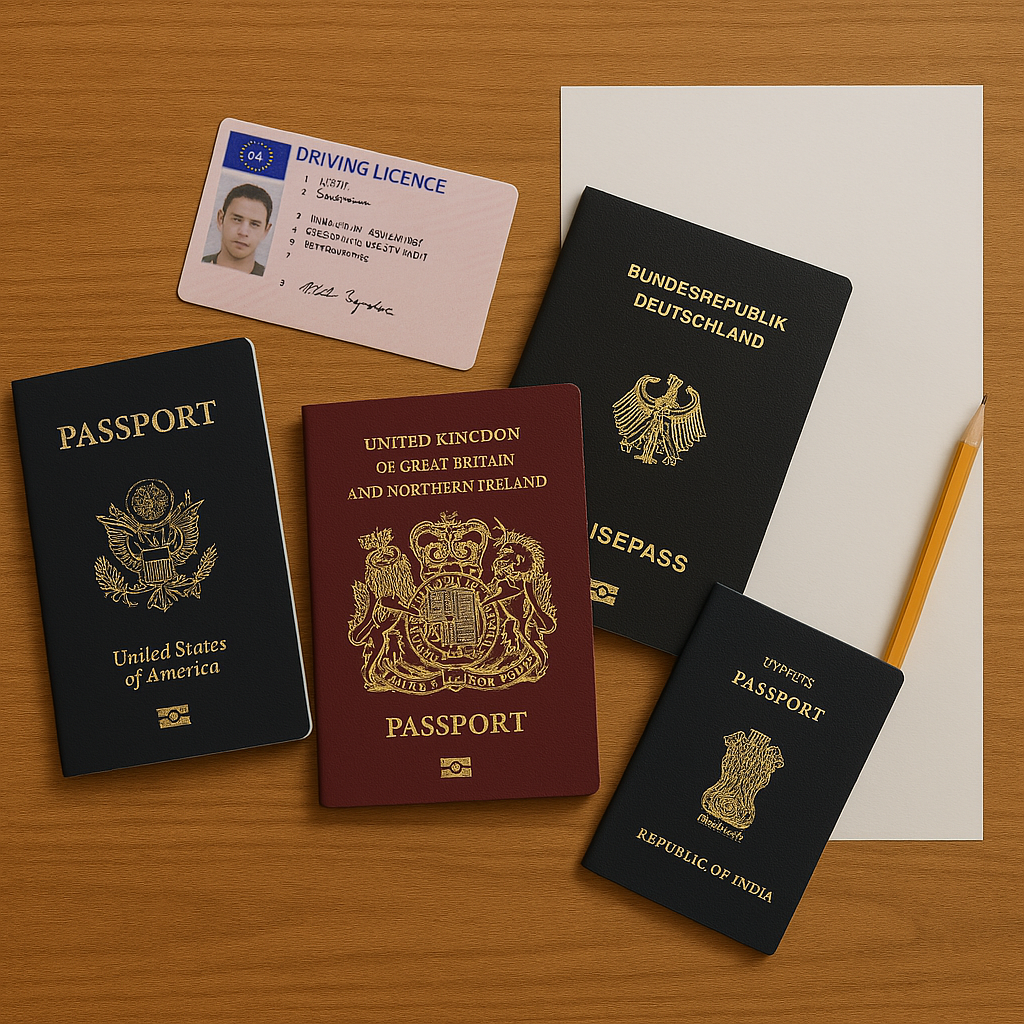
A photo of a number of different international passports on a table next to a piece of paper, pencil and drivers license

Managing in-centre exams on an international scale comes with a range of logistical challenges.  Beyond the practical aspects of setup, administration, and invigilation, less obvious tasks – such as verifying candidates’ identities – can introduce unexpected risks and complications.

Ensuring the accuracy of exam candidates’ IDs worldwide is complicated by differing regional document standards, differing exam procedures, and the risk of fraud.  Ultimately, if candidates sit the exam with an inaccurate ID, or without their ID being scrutinised at all, the integrity of the entire exam is undermined.

In some cases, the exam day procedures set by awarding bodies and test centres can unintentionally create challenges for accurate ID verification.  But first, what are some of the practical issues around proving a candidates identity?

The Practicalities

The fact that different countries and regions have varying types of ID documents makes it difficult to establish a universal verification process, and can pose a practical nightmare when it comes to proving a candidate is who they say they are.  Awarding bodies may specify that only a particular type of ID is valid for verification, unaware that this form of ID is not commonly used in all countries or regions.  This can lead to confusion and stress for candidates on exam day, as the form of ID they present is turned away.

Our invigilators frequently see candidates presenting digital IDs – these are commonly used in many countries, such as India and Nigeria, and were introduced to solve the problem of a large number of citizens having no ID at all.  However, digital IDs are not accepted by every awarding organisation.  This leads to last minute stresses for candidates who use them successfully in all other areas of their daily lives.

Another practical issue regarding international IDs is that some forms of identification document do not contain the same information as the Western forms of ID we are used to.  A good example of this is in Pakistan, where candidates will often have their father’s name on their ID, meaning it does not match the name they registered for their exam with.  This can create confusion on exam day when verifying a candidate’s identity, as they may present a form of ID that is completely normal and accepted in their country, but does not meet the expectations of the awarding body.

Fraud and Malpractice

Beyond the practical challenges of verifying candidates’ identities on an international scale, there’s also the issue of fraud and malpractice.  Identity fraud is something we have encountered many times worldwide, but it is particularly prevalent in countries like India.

It may sound unbelievable, but some students really do seem to think sending an impersonator to sit their exam will give them a better chance of good grades than if they were to do it themselves.  This is something we have witnessed many times in India, a country where there are simply not enough jobs for the millions of people searching for employment – this leads to extremely competitive examinations and, as a result, extremely high levels of cheating.

One particular case highlights the lengths some people will go to for a good grade in this region.  Last January in Kotkapura, a man put on some lipstick, donned a salwar kameez (traditional Indian women’s dress), and impersonated his girlfriend so that he could take her exam for her.  Notably, he carried two fake ID cards, but was handed over to the police after his fingerprints did not pass biometric inspection – whilst cheating might be rampant in India, it is rightly recognised as what it actually is – fraud.

The ability to buy fake IDs, like those mentioned above, plays a key role in many impersonation attempts.  Unfortunately, fake IDs are relatively easy to buy, and are only getting more convincing with the help of AI and advanced editing tools.  Of course in some cases, even when test centre staff recognise a fake ID, corruption can allow these fraudulent candidates to slip through the cracks.  While uncommon, collusion between candidates and test centres is something we have encountered before, and it could potentially allow impersonators to sit an exam.

Similar to impersonation, surrogacy or proxy candidates are another examination risk associated with identity fraud.  This is when someone acts as a substitute for an exam candidate, but isn’t necessarily claiming to be the candidate.  One of our invigilators saw a case of surrogacy whilst working at an exam centre in Indonesia.  They asked a candidate for identification, which they could not provide, only to be told by this individual that they were a substitution for someone else who “could not make it.”  Our invigilator dealt with the situation promptly and ensured that the substitute candidate was removed from the exam centre.  Needless to say, the normalisation of surrogate candidates in certain regions is concerning and poses a significant risk to academic integrity.

Exam Procedural Issues

Both practical challenges and the risk of malpractice make accurately identifying candidates particularly difficult.  But certain exam procedures set by awarding bodies can further complicate the process.

While awarding organisations are united in their desire to prevent ID fraud and stop anyone taking an exam who shouldn’t, each separate organisation has their own way of doing things.  Some awarding organisations will let a candidate take an exam without an ID, but want it to be reported afterwards.  Meanwhile, others will only accept one specific form of ID, and if the candidate cannot provide that exact document, they are not allowed to sit the exam at all.

There are also many awarding organisations that are extremely reluctant to turn people away on exam day.  This makes it harder to prevent someone from taking an exam, even if they do not have the ‘required’ documentation.

Where Do We Go From Here?

As we have seen, verifying candidate identities in exams across the globe is anything but straightforward.  From varying ID standards and digital identification issues, to fraud risks and inconsistent exam procedures, there are multiple factors that can compromise exam integrity.

To combat these challenges, a more standardised and collaborative approach is needed, as well as a greater understanding of global variants in documentation.  Ideally, awarding bodies, test centres, and invigilators should all work together to implement stronger verification methods, whether this be through improved training, better technology or clearer policies.

Ultimately, preventing exam fraud is not just about identifying rule-breakers; it is about ensuring a fair and reliable system for all test-takers.   With greater collaboration, we can move toward a future where identity verification is not only rigorous and secure, but also adaptable to the needs of a global testing environment.

VICTVS Core Values: Honesty

An illustrated coat of arms with an open book in the centre, scales to the right and a sand timer on the left.

At VICTVS, we have four core values which underpin all the work we do and the way we operate: Honesty, Integrity, Professionalism and Courage.  These values are integral to the company and we make sure all new team members understand and uphold them from the very start.

Each quarter, we will explore a different VICTVS value, examining the role it plays in the business and how we see it in practice across our operations.  In this blog post, we will be looking at honesty.

The Importance of Honesty at VICTVS

Honesty is a cornerstone of effective invigilation and exam management, playing a crucial role in maintaining the integrity and credibility of the examination process.

It is vital to our business because it fosters trust between invigilators, candidates, and the institutions they represent. Candidates must trust that their efforts will be evaluated fairly, while institutions rely on invigilators to uphold the standards of the examination process.  An invigilator’s honesty ensures that this trust is well-placed.

Honest invigilators also ensure a level playing field for all candidates.  By strictly following examination rules and protocols, they prevent any form of cheating or misconduct.  This guarantees that every candidate’s performance is assessed on their own merit, enabling them to take their exams in the knowledge that no one has an unfair advantage.

Honesty in invigilation and exam management is also crucial to maintaining academic credibility.  Ultimately, if candidates or stakeholders suspect any form of dishonesty from exam management or invigilators, it can undermine the legitimacy of the entire assessment.  The commitment of these individuals to acting with honesty helps preserve the integrity and reputation of the examination body, safeguarding the value of the qualifications earned by those sitting the exams.

Importantly, honest behaviour sets a powerful example for others.  By upholding Honesty, Integrity, Professionalism, and Courage at our head office, we demonstrate to the entire VICTVS Global Network that these are the values we expect from all of our team members.  In turn, we can rely on our network to reflect these values in their work, encouraging both candidates and colleagues to do the same.  This top-down influence helps to foster an environment where honesty is the norm, and where candidates feel less likely to engage in dishonest behaviour.

Finally, honesty plays a key role in preventing corruption.  Corruption can infiltrate any level of an organisation, often starting at the top.  By embodying honesty, all of our employees can resist and counteract corrupt practices.  This steadfastness helps protect the examination process from being compromised by unethical behaviour.

Final Thoughts

Beyond its crucial role in invigilation and assessments, honesty is a core value we uphold within our headquarters, guiding communication between individuals and departments.  We believe that clear and transparent communication is essential to building trust, promoting collaboration, and ensuring everyone feels heard and respected.

Honesty is more than just a value – it is a guiding principle that shapes the way we work, interact, and uphold standards in every aspect of our business.

At VICTVS, we believe that embracing honesty not only protects the integrity of the examination process, but also strengthens the trust placed in us by candidates and institutions worldwide.  As we move forward, we remain committed to fairness, transparency, and doing what is right, ensuring we uphold the highest standards in everything we do.

VICTVS Global Network Member Spotlight: Soulafa Al Joukhadar

We have decided to shine a light on some of the amazing people who work in our VICTVS Global Network.  With over 5,000 members worldwide, our network is filled with inspiring individuals making a difference every day. Through these interviews, we hope to highlight their incredible stories and achievements.

In this interview, we shine a spotlight on Soulafa Al Joukhadar and her extraordinary journey.

Soulafa, you’re based in the Netherlands after fleeing the Syrian civil war with your family.  Can you tell me more about this: when did you decide to make the move, and what was it like moving to a completely new country and culture?

Syria, my homeland, is irreplaceable in my heart.  But when we could no longer find enough food for our children or afford basic necessities, and when sending them to school became life-threatening due to shelling and missiles, we had no choice but to make the hardest decision: to flee in search of safety.  At the end of 2014, my husband decided to migrate alone, fearing for our lives and those of our children, Sarah and Hasan.  He travelled from Syria to Lebanon, then to Turkey, where he spent months attempting to cross the sea.  After several failed attempts, he finally reached Greece, but was stranded in a dangerous area before being rescued.  He was detained in Athens for nearly a month before finally making it to the Netherlands.

One day changed everything.  On September 8th 2015, my 14-year-old relative was killed by stray shrapnel.  I could no longer stay.  As soon as our visas were ready, I asked my husband to book our tickets.  I left on October 8th.

When we arrived, we were overwhelmed.  We had forgotten what basic necessities like electricity, water, and food felt like.  But more than anything, we deeply missed our family – especially my mother and father.  It was also wonderful that the Dutch people spoke English fluently, which made many things much easier for us.

How has your life changed since moving to the Netherlands?

Life here is monotonous and dull: no work, no family.  The weather is different, especially the Dutch winters.  We were frightened by the sounds of thunder and fireworks, as they reminded us of war.  But after a while, and with language school, things became a bit easier.  Everything was a challenge for us.  I had to learn how to ride a bike to get to school, and so did my children.  Even shopping was a challenge.  We had to read and translate everything to make sure it was “halal.”

A photo of a woman wearing a leopard print hijab and smilingBut what I didn’t expect happened.  In December 2016, my mother passed away.  That moment shattered me.  I couldn’t comprehend it, especially since she wasn’t sick.  It happened suddenly.  I was so worried about my father, knowing how much my mother meant to him and with no one else there, as my only sister had migrated to Germany before me.  I had to return alone to Syria for a month to care for my father and gather the necessary documents to bring him to the Netherlands.  Despite many attempts, the government rejected our application.  Two years later, my father passed away as well.


I spent nearly five years lost, trying to rebuild myself.  I completed language courses and tried to find work but unfortunately, I could only do volunteer work which, in return, helped me practise Dutch.

What made you want to get involved with VICTVS?

Finally, after the tough COVID period, I found a job that required English, which I hold a university degree in, through digital job websites.  I joined the great team at VICTVS.

When you’re not invigilating exams and supporting VICTVS, what are you doing?

I have a bachelor’s degree in Translation and Interpretation.  However, in the Netherlands it was very difficult to find a job in English as most opportunities were volunteer-based.  Fortunately, I found a job in a drugstore where I learned a lot.  I had to push myself to speak Dutch, which greatly improved my Dutch skills.  I worked there for two years, and then I found another job that is very satisfying for me.  I now work for a medical company as an administrative employee, assisting both the owner and the general manager.

You’re always overflowing with positivity and professionalism.  How do you stay so positive?  Please give us your tips!

I am naturally a positive person and I believe – especially after the experience of war – that one must remain hopeful and appreciate the blessings they have.  After the war and the loss of my parents, I began to find the happiness I had completely forgotten.  This has only increased my positivity.  As for professionalism, I thank you all.  I believe this comes from my previous work experience in Syria.

What are some current goals that you are working towards?

My goals are simple.  I want to be a successful woman in my life, standing by my husband who has sacrificed so much for us, and I want my small family to be happy and successful in every way.  And finally, I am working on obtaining a driver’s license as well, which may open up new job opportunities for me.  I dream of owning my own little store, selling souvenirs that I might collect from traveling around the world.

VICTVS Global Network Member Spotlight: Stella Mwangi

In this new series, we are shining a light on some of the amazing people who work in our VICTVS Global Network.  With over 5,000 members worldwide, our network is filled with inspiring individuals making a difference every day, and we hope highlighting their incredible stories and achievements will inspire you.

In this first interview, we shine a spotlight on Stella Mwangi and her extraordinary journey.

A woman stands in front of a park smiling at the camera with her arms folded.

You’re originally from Kenya but moved to Hungary, I can imagine that involved a lot of courage.  What made you decide to move to Hungary?

Moving to Hungary was a bold step and actually my first time outside Kenya, so it was exhilarating and I was full of curiosity about the world beyond Kenya.  I always knew I wanted to do a Masters abroad – or as we Kenyans love to call it, ‘majuu’-  with Europe as my top choice.  So, during scholarship application season, my first option was a Masters in the UK and my second was Hungary.

Unfortunately, my UK masters scholarship was rejected, but my Hungarian one was accepted.  However, I have grown so fond of Hungary – Budapest in particular- and it feels like everything worked out exactly as it was meant to.  Now, I am pursuing my Masters in Environmental Science in the biggest university here and it still feels surreal that my dreams came true and  I’m officially the girl in majuu!

What made you want to study sustainability and can you tell me some more about the work that you do?

In my growth as a community advocate, witnessing a myriad of challenges facing society, I’ve seen that it’s necessary to gain more knowledge on sustainability and the environment to gain science-backed solutions for vulnerable communities.

As humans, we are heavily reliant on natural resources for our survival, and unsustainable use has major implications  leading to issues such as lack of food and water – especially in developing nations.  It is a delicate balance that requires in-depth knowledge on different aspects of the ecosystem to ensure we have access to basic needs whilst maintaining a healthy environment.  I’m striving to learn and apply this knowledge to improve the quality of life for different communities, and I’m doing that in the water project I have back in my hometown Nakuru.

What does your work in Nakuru involve, and how does it feel to be giving back to them?

I am currently working on a water project aimed at increasing access to clean drinking water for an informal settlement in Nakuru town.  For context, the project is based in the PISTIS Home for the destitute, which doubles as an orphanage and school, and is located in the Rhonda informal settlement.  Unfortunately, our school borehole water is unfit for direct consumption due to impurities and other issues such as high fluoride levels, and this is a health hazard to the students and community, risking water borne diseases and other disorders such as dental fluorosis from the high fluoride levels.

This is how the idea to start the project came about as we realised by filtering the water, we can also sell to the people in Rhonda at an affordable rate, as the community also struggles to access clean water – the profits from the project can then be used to support the children at the home, since most are from disadvantaged backgrounds, and others are total orphans who board there.  We also plan on selling the water to other institutions in the larger Nakuru area to ensure the project can sustain itself.

We applied for a grant to fund the project as it is quite expensive procuring the machines, and this is how we’ve been able to run the project.  I am indebted to my amazing team who have made sure it is running strong, even while I am away.

It is deeply fulfilling to know that this project will protect the health of the kids and the community at large.  Being made aware of the effects of excess fluoride in my Environmental Science studies and unsafe water in general, I am happy that I play a part in ensuring kids teeth are protected, as dental fluorosis begins at the developmental stage.  As William Arthur Ward once said, “a warm smile is the universal language of kindness” – to me, there’s nothing more rewarding than helping create those smiles and ensure healthy living.

What’s one thing you wish more people knew about you?

That despite being a community advocate, I still struggle with stage fright.  One of my proudest moments was when I presented on a global stage in Copenhagen for a climate caucus, with the event also being live streamed.  You can bet I was extremely nervous before my turn, but seeing myself on that stage, quite composed and advocating for millions of African students, is a moment I truly cherish.  I am immensely proud that I pushed myself to do that.  I also owe it to my friends and colleagues who believed in me and nominated me to be the speaker that day.

I am still working to overcome my stage fright and I’ve gotten much better in my presentations, even at school.  By the time I’m doing my thesis defense, I’m sure I’ll have shown immense growth.

So, this is your sign to do it scared, do it nervous, and you’ll be surprised at what you’re capable of.

What are some current goals that you’re working towards?

Besides successfully finishing the water project and my masters degree, I am working towards learning more about water filtration techniques in Europe and different methods that water quality standards are adhered to, especially those that would also be applicable back home.  Being in a different country and continent offers a fresh perspective on other working solutions.

I want to build a scalable model that can be adapted by other regions while collaborating with those who are in water safety projects in other vulnerable communities, as PISTIS is just one of many.  Now, with climate change worsening natural resource scarcity, there is more need to build resilient communities.  It is worthwhile to note that climate change is also disproportionately affecting women and girls, especially in communities with pre-existing gender inequalities, and so access to basic needs such as clean water also ensures their safeguarding.

VICTVS Newsletter March 2025

Test Centre Security: Why Every Detail Matters, Even the Paper

At VICTVS, maintaining academic integrity is non-negotiable, and in most exams, this means preventing candidates from leaving with any note paper. While it may seem like overkill to those outside of the assessment space, we know that this is an important step in preventing cheating.

Most exam bodies already require note paper to be collected, but we go further. We have created our own serialised note paper, designed to streamline the process and make it easier to trace notes back to individual candidates in cases of suspected malpractice.

An aerial photo of white, blank note paper on a wooden table, labelled with the VICTVS logo and serial numbers at the top and bottom.

Our serialised note paper will be used in every VICTVS exam, so clients can remain confident we are doing all we can to prevent cheating and preserve academic integrity.  With our services now available in every country in the world, and test centres in over 3,000 locations, we continue to set the standard for secure exam delivery on a truly global scale.

To read more about how our serialised note paper will benefit your exams, click here.  You can find out more about our services here.

The VICTVS Exam Hack 2025

The annual VICTVS Exam Hack returns this July – the only time we ever openly invite candidates to cheat in an exam.

Participants will sit an exam hosted by VICTVS and work alone or in pairs to cheat without being caught by our expert invigilators.  The cheat can be carried out using old school analogue methods or digital tools, and the most creative entry will be rewarded with a $1,000 cash prize.

Why do we do this?  Because staying ahead of new cheating methods is more crucial than ever, as the technology we used everyday continues to evolve. By hosting the hack, we can keep an eye on new and developing methods of malpractice, ensuring that we can continue to adapt and lead the way in exam security and integrity.

To find out more about the VICTVS Exam Hack, click here, and watch our YouTube trailer below. 

The VICTVS Podcast, ‘Revision Notes – February’ COMING SOON

In our upcoming episode of The VICTVS Podcast, we bring you the second edition of Revision Notes, the series where we discuss the latest in assessment and education news, as well as any VICTVS news.  This month, we are focusing on cheating in the news as we prepare for the VICTVS Exam Hack 2025.

To be the first to watch this episode, subscribe to our YouTube channel.  You can also catch up with previous episodes there, or listen via Spotify and Apple Music

Other News 

  • China’s Supreme Court Calls for Crack Down on Paper Mills:  China’s supreme court has called for lower courts to crack down on ‘paper mill industry chains’ and for research fraud to be severely punished.  This comes after a large number of cases against paper mills were brought to lower courts – not in cases of academic fraud, but by customers who never received the writing they paid for and who were suing for non-fulfilment of contracts.  More on this at Nature
  • The Exam Struggles of Visually Impaired Students:  The Irish advocacy group Féach, which supports parents of blind and visually impaired students, has been raising awareness regarding Ireland’s “ad-hoc” and poorly modified exam papers, as well as issues regarding extra time.  In one instance, examiners thought a student was deaf and not blind.  More at IrishExaminer.
  • UK Universities Warned to ‘Stress-Test’ Assessments as 92% of Students Use AI:  A survey of 1,000 students showed an ‘explosive increase’ in the use of generative AI in their studies, with 88% specifying they use tools like ChatGPT to help complete their assessments.  When asked why they use AI, 51% cited time-saving benefits, while 50% also claimed it improved the quality of their work.
  • ‘Contract Cheating’ Uncovered in University Scandal:  Dozens of students at the University of East Anglia were found to be using essay mills to complete assessments as part of their economics masters course.  In the academic year 2023/24, 69 cases of cheating were recorded at the university, up from less than five in each of the previous four years.  More at the Telegraph

Thanks for reading our newsletter.  Please subscribe using the form in the sidebar if you would like to receive future editions directly to your inbox.[us_separator size=”custom” height=”30px”][us_post_author link=”%7B%22type%22%3A%22author_page%22%7D” avatar=”1″][us_separator size=”small”][vc_column_text css=”%7B%22default%22%3A%7B%22font-size%22%3A%2220px%22%7D%7D”]    Share this article[/vc_column_text][us_sharing providers=”email,facebook,twitter,linkedin,vk,whatsapp” counters=”hide”]

Test Centre Security: Why Every Detail Matters, Even the Paper 

An aerial photo of white, blank note paper on a wooden table, labelled with the VICTVS logo and serial numbers at the top and bottom.

At VICTVS, we are constantly refining our exam security measures to help prevent academic malpractice.  One key area of concern is ensuring that note paper used during exams does not leave the exam room, preventing potential cheating and safeguarding exam integrity.

To address this, we have developed our own serialised note paper, designed to help invigilators track and manage candidate notes more effectively.  But why is this such an important issue?

The Risks of Note Paper Leaving an Exam Room

The major problem with students taking note paper out of exams is that it can lead to information leaks and cheating. Candidates might write down exam content which can be shared with others who are yet to sit the same exam – this is especially the case when it comes to international exams, as candidates in one country may finish their exam before candidates in another country start theirs.

Copying questions onto note paper and taking it out of exams can also result in exam material appearing online which could help candidates cheat in the future.  With paper exams this is more of an issue, as there is often less variation between exam questions year-on-year than there is in a computer-based exam.

Due to the risks associated with candidates taking note paper out of exams, many exam boards have strict regulations on which materials can leave the exam room.  They often require note paper to be either disposed of or securely stored for a set period by the exam hosting company (such as VICTVS).  This helps maintain a fair testing environment by ensuring all candidates follow the same rules, while also providing accountability and accurate record-keeping.  Additionally, storing the note paper allows awarding bodies to review it as potential evidence in cases of suspected cheating.

The VICTVS Solution

To further mediate the risks associated with candidates taking away notes, we have created our own serialised note paper to help invigilators keep track of it in exams.  This will be used across all VICTVS exams, maintaining consistency and integrity across the board.  But how does it work?

Our specially produced exam note paper features a perforated section.  Before the start of each exam, invigilators will initial and date the top part of the paper before tearing off the main section and handing it to the candidate for use.

Each page of our exam note paper features a matching serial number on both the top and bottom sections.  This ensures that when the candidate’s used note paper is collected in, it can be accurately paired with the top section initially kept by invigilators.

A close up photo of the bottom of the VICTVS labelled note paper, with a returns box at the bottom of the paper allowing invigilators to sign their initials and date of collectionAdditionally, at the bottom of the used note paper there is a designated box where invigilators will record the collection date alongside their initials, confirming that the paper was retrieved on time by a member of the VICTVS team.  This ‘return box’ at the bottom of the page also acts as an extra deterrent to candidates as it reiterates to them that the pages will be collected in and potentially referred to later.


This exam paper has recently been trialled across eight exam venues in the UK, as well as one in Hong Kong, and we are extremely happy with the results.  We are looking forward to seeing the impact it will have on all future exams hosted by VICTVS, enhancing integrity while streamlining the practical aspects of invigilation.

In-Centre Exam’s by VICTVS

Successful in-centre exams require both meticulous attention to detail and a strong, reliable infrastructure.  That is why our exam solutions cover every aspect, ensuring both security and a smooth candidate experience.

With a global network of over 3,000 audited exam venues and more than 5,000 professional invigilators, we operate in every country in the world, ensuring the highest standards of fairness and integrity.  Our newly introduced serialised note paper is just one example of how we continuously develop our processes to stay ahead of evolving challenges in exam security.

By combining global reach with meticulous attention to detail, VICTVS provides in-centre exam solutions that exam bodies can trust.  To find out more about our services and how we can support your exam needs, contact us here.


VICTVS Newsletter February 2025

A student doing an exam while an invigilator walks behind them

Why Professional Invigilation Matters to Your Candidates 

Invigilators are not just there to hand out papers and keep an eye on the clock.  A well-trained invigilator ensures that exams are conducted fairly, securely, and professionally—something that is more important than ever in today’s high-stakes educational environment, where candidates are constantly finding new and inventive ways to cheat.

We treat invigilation with the seriousness it deserves at VICTVS.  Our global network of professional invigilators undergoes rigorous training to uphold the highest standards of exam security and academic integrity.  Whether it is a high-profile certification exam or a niche industry assessment, our invigilators are equipped to handle complex exam conditions, ensuring compliance with both institutional regulations and awarding body requirements.

Invigilation deserves greater professional recognition from educational institutions, policymakers and the media.  To understand how undervaluing the profession impacts academic integrity, check out our blog.  For more information on how VICTVS can support your invigilation needs, click here.

The Ethical Implications of Exam Hacking

It is safe to say that cheating in exams is not what it used to be.  Gone are the days of scribbling answers on your hand or sneaking in a cheat sheet.  The rise of digital exams has opened up a whole new world of high-tech hacks to help candidates cheat in, or even totally shut down, an exam.

But while candidates might see cheating as a risk worth taking, the ethical consequences are significant.  Cheating in an exam, whether it be through technical or analogue means, undermines the integrity of academic assessments and creates unfair advantages, devaluing the accomplishments of honest students.  It also normalises unethical behaviour and sets a precedent for future misconduct in professional settings.

We look in greater depth at the ethical and legal consequences of exam hacking – as well as ways to prevent it – in our latest blog piece.

The VICTVS Podcast, ‘When Exam’s Go Wrong – Cheating Your Way to the Nuclear Launch Codes’

This year, we have an exciting lineup of podcast episodes planned covering topics like contract cheating, exam hacking and more, all featuring fantastic guest speakers.

In the meantime, you can checkout a past episode on cheating in exams with special guest Derek Newton of The Cheat Sheet.  We examine some of the most extreme cases of academic dishonesty, including the shocking incident where U.S. Air Force nuclear missile commanders were caught cheating on their monthly proficiency tests.

To make sure you never miss an episode of The VICTVS Podcast, subscribe on Spotify, Apple Podcasts, or YouTube.

Other News 

  • Ofqual to Fine Pearson Exam Board £250,000:  Ofqual intends to fine Pearson £250,000 for failing to identify conflicts of interest among 195 of its GCSE, A-level, and BTEC examiners, as well as failing to follow its own policies on exam paper confidentiality.  This is a shocking case that shines a light on malpractice in the industry.  Tes has the full story.
  • Poorer Pupils Less Likely to Get Extra Time in Exams:  Last week, The Times reported that in Scotland, school students living in deprived areas are less likely to receive extra time in exams.  According to some parents, extra help for those who need it is often granted purely based on “luck.”
  • Education Secretary Outlines Plans to Modernise Education Sector:  The UK’s Education Secretary, Bridget Phillipson, has announced plans for a “digital revolution” in schools, aiming to modernise the education sector and improve access to learning tools.  Phillipson claims that barriers to opportunity will be broken down in classrooms, with every student and teacher able to access the tools they need.  More on this here.
  • Tackling Academic Dishonesty: Contract Cheating in 2025:   In case you missed it, we recently explored the growing issue of contract cheating on our blog, looking at how these companies are using AI to enhance their services and what this means for academic integrity.  Read the full piece here.

Thanks for reading our newsletter.  Please subscribe using the form in the sidebar if you would like to receive future editions directly to your inbox.[us_separator size=”custom” height=”30px”][us_post_author link=”%7B%22type%22%3A%22author_page%22%7D” avatar=”1″][us_separator size=”small”][vc_column_text css=”%7B%22default%22%3A%7B%22font-size%22%3A%2220px%22%7D%7D”]    Share this article[/vc_column_text][us_sharing providers=”email,facebook,twitter,linkedin,vk,whatsapp” counters=”hide”]

Why Invigilation Matters to your Candidates

A photo of students sat in an exam hall taking an exam with their backs to the camera.

Exam invigilation has long been considered a casual side job – something a family member might do as a favour to a student’s school.  Growing up, I certainly never viewed my exam invigilators as professionals.  Instead, they were familiar faces, a source of comfort rather than authority.

These days, my perception of invigilation has shifted drastically.  Working at VICTVS, I have seen first-hand the rigorous training invigilators undergo and understand that this is a legitimate profession requiring complex skills, lateral thinking, vigilance, and dedication.  I have also invigilated exams myself, both remotely and in-person.  Yet, the public perception is still that invigilation is a low-skill, easy way to earn some money by just watching people taking an exam.

The Media’s Role in Shaping Perception

Last year, the BBC published a piece about an SQA exam invigilator who claimed she had only caught “three exam cheats in 24 years.”  Those of you who listen to The VICTVS Podcast will have already heard me and global technology expert Geoff Chapman discussing this piece, but for those who haven’t, I’ll summarise the key points here:

  • Invigilator Dr Laird claims she has only witnessed three instances of cheating in her 24 years in the role
  • She states that cheating in exams is ‘very rare’
  • Various challenges faced by invigilators are discussed, including noisy environments and unexpected disruptions

From my own experience, this invigilator’s claims seem unlikely.  In the article, Dr Laird states that the incidents of misconduct she witnessed included a student leaving their phone in their pocket and another sneaking in notes.  But these are common forms of malpractice – I have personally witnessed multiple cases of both within a single exam session.  If an invigilator has only identified three instances of cheating in nearly 25 years, it raises concerns about the level of vigilance and training expected of invigilators in some settings.

While the BBC article acknowledges the importance of invigilators, it fails to present the role as a professional one.  Rather, the casual tone of the piece and its focus on light-hearted anecdotes – such as avoiding squeaky shoes and dealing with amorous pigeons – overshadows the serious responsibilities of invigilators.  By portraying the job as an informal, part-time gig, media coverage like this risks reinforcing misconceptions about the job and the expertise it requires.

Why Professional Exam Invigilation Matters

The integrity of assessments depends on properly enforced exam conditions.  Without well-trained, alert, and dedicated invigilators, exams would be vulnerable to malpractice, and qualifications could lose their credibility.

Ultimately, a person’s qualifications are only as meaningful as the conditions under which they were gained.  If you found out your brain surgeon had become qualified in an exam hall with no invigilators, where students were allowed to talk to one another and notes were smuggled in freely, would you trust them?  I know I wouldn’t.

Similarly, it would be hard to trust a self-proclaimed expert on anything in the academic world if it later became know that their exams had not been properly monitored, and instances of cheating had gone unchecked.

As well as safeguarding academic integrity, good invigilators also ensure that all institutional and legal regulations are being complied with.  This means making sure students abide by the rules of their specific institution, as well as the awarding body providing the exam.

Beyond this, invigilators can be seen as protecting students from themselves.  After all, when given the opportunity, it’s easy to see why anxious or pressured students may be lured to try and artificially improve their exam results.  Invigilators can prevent this from happening and serve as impartial enforcers of fairness, ensuring that students earn their qualifications honestly.

Why Invigilation Matters to Your Candidates

Good invigilation is a key part of the candidate experience during an exam.  Invigilators serve as on-site representatives of awarding organisations, embodying key values such as honesty, integrity, and professionalism.

A well-trained invigilator not only ensures that exams run smoothly, but also reassures candidates, providing guidance and answering any practical questions they may have.  Exams are stressful enough and any extra support that can be given during this time is invaluable.

A strong invigilator presence also increases candidate confidence in the value and credibility of a qualification as they can see that everyone is sitting the exam under the same strict conditions.

The Consequences of Undervaluing Invigilators

Despite their critical role, invigilators are often treated as an afterthought.  The perception of invigilation as a “side hustle” is not only dismissive, but also detrimental to the quality of exam administration.  Articles like the BBC piece mentioned earlier perpetuate this issue by trivialising the job rather than recognising the expertise it demands.

When invigilation is undervalued, institutions may underestimate the level of training required, leading to inconsistent exam monitoring standards. This, in turn, creates a self-fulfilling prophecy: if invigilators are not given the tools, training, and respect they deserve, they may not meet the high standards necessary to uphold academic integrity.

Meanwhile, experienced, well-trained invigilators (such as those at VICTVS) are left underappreciated, despite their expertise and commitment to fairness.

The Skills and Expertise Required for Professional Invigilation

There are a number of skills needed to become a professional invigilator, all of which are vital to doing the job at a high standard.  These are:

• High Attention to Detail – Invigilators must stay alert, recognising even the subtlest signs of malpractice while ensuring candidates and venues comply with all regulations.

• Strong Knowledge of Exam Protocols – A well-trained invigilator understands the specific rules set by awarding bodies and knows how to handle potential cheating incidents appropriately.

• Effective Communication – Invigilators must clearly relay information to candidates while maintaining a professional, non-disruptive presence in the exam hall.

• Crisis Management – Whether dealing with student disputes, medical emergencies, or external disruptions, invigilators must remain calm and enforce safety protocols.

Ensuring candidates with accessibility requirements and disability needs are looked after is also a vital part of being an invigilator.  This is especially important now, as the number of SEN requests continues to rise across institutions in the UK.  Proper invigilation should ultimately support accessibility and inclusivity in exams.

Our Invigilators

Invigilators at VICTVS go through a comprehensive recruitment and selection programme to ensure they can deliver everything that I have described above, to all of our candidates, anywhere in the world.  Each invigilator is a valued member of the VICTVS Global Network and acts as our ambassador.  They receive comprehensive guidance on the specific requirements and expectations of the awarding bodies we work with, enabling them to adapt to varying guidelines and deliver consistent excellence in exam management.

Each year, our invigilators oversee exams for hundreds of thousands of candidates, from major cities to remote locations – including, quite literally, the middle of the desert.  Our focus is on creating equal access to education while safeguarding the integrity of the exam process, ensuring that every assessment is conducted with professionalism and care.

VICTVS is raising the bar for professional invigilation services.  We aim to set a benchmark for the industry and highlight the critical role skilled invigilators play in shaping the future of education.

Final Thoughts

Invigilation is a job which requires in-depth training and dedication to be done well, just like any profession.  Without skilled invigilators, educational integrity would be undermined, and the value of qualifications would be eroded.

Educational institutions, policymakers and media outlets should acknowledge and invest in the professionalism of exam invigilation, and give invigilators the appreciation and respect they deserve.  Either that, or we devalue the educational and assessment system as a whole.

It’s time we stop treating invigilators as an afterthought, and start recognising them as the essential professionals that they are.