VICTVS Conference 2025: Collaborating on the Future of Assessment

A panel discussion featuring esteemed guests at the first ever VICTVS conference. Four people sit on stools, all smiling.

[vc_row][vc_column][vc_column_text]August kicked off with a milestone moment for us as we held our first ever VICTVS Conference – an event that brought together experts in assessment and academic integrity, VICTVS head office staff, and members of our global network.  Our goal was to create a space where VICTVS and other professionals could come together to explore the most pressing challenges in assessment – from the rise of AI-enabled cheating, to the complexities of exam design and reasonable adjustments.

After a welcome address from VICTVS CEO Ben Clayson, we heard from a range of guest speakers: 

  • Niamh Pierce, Head of Research, the Assessment Security Research Group (ASRG) 
  • Kirsty Parkinson, Assessment Development Manager, CIPS 
  • Emily Hart, Operations Implementation Lead, VICTVS 
  • Adrian Richardson, Assessments Manager, School of Medicine at the University of Nottingham 
  • Wassim Mekerri, VICTVS Global Network member  
  • And our keynote speaker, Michael Walford-Williams 

The day also included a compelling panel discussion on the hot topic of reasonable adjustments.

‘Devices of Deception’ 

One of the day’s most memorable talks came from Niamh Pierce, Head of Research at ASRG, the research division of VICTVS.  In her presentation, Niamh explored the growing use of both wearable and non-wearable tech to help candidates cheat during in-person exams, highlighting some of the readily available tools now being marketed to candidates via platforms like TikTok. 

Midway through her talk, Niamh shocked the audience by revealing she’d been wearing multiple cheating devices the entire time.  These included: a discreet button-hole camera, a pen doubling as a camera, and a pair of smart glasses with teleprompter-style lenses which she had been using to deliver her entire talk. 

This was an important reminder of how sophisticated cheating technology is becoming, and why proactive detection strategies and staff training are more important now than ever. 

Niamh explores these issues in greater detail in ASRG’s latest whitepaper,Devices of Deception: The Cheating Tools Undermining Assessment Integrity.  You can find out more about ASRG’s work and become a member here.  

Designing for Integrity and Delivering Globally 

Next, Kirsty Parkinson from CIPS gave an insightful talk on assessment design, highlighting how thoughtful assessment construction can make cheating more difficult, and ensure that exams are fair and meaningful. 

As AI use in coursework grows, exam design has become a key topic in protecting assessment integrity.  It’s now more important than ever to explore alternative assessment methods that limit opportunities to rely on AI. 

Kirsty gave examples of different methods of assessment, their pros and cons, as well as the potential threat posed by AI or other modes of malpractice.  Her talk underscored how difficult it is to design assessments that are both secure and candidate-friendly.  Crucially, her presentation also highlighted the amount of work that will need to go into developing assessment methods as cheating technologies continue to evolve. 

Emily Hart then took to the stage to share stories from VICTVS’s work delivering exams in challenging environments around the world.  Her talk shone a light on the dedication, logistics, and creativity required to make exams happen safely – even in extreme conditions. 

Emily’s talk highlighted what’s at stake in exam delivery, especially in remote or high-risk regions.  For many candidates, missing an exam isn’t an option –  for exam delivery team’s, this can mean linking a test centre’s power to a hospital during a natural disaster, or navigating political unrest to deliver life-changing opportunities.  These real examples from Emily highlighted the team’s commitment, and it was inspiring to hear her reflect on delivering exams under such tough conditions. 

To learn more about our work and how we deliver assessments on a global scale, click here.

Rethinking Reasonable Adjustments 

Later in the afternoon, Adrian Richardson from the University of Nottingham led a thought-provoking session on reasonable adjustments.  With increased public attention on this issue – especially following Ofqual’s recent update on adjustments data – Adrian’s talk felt especially timely. 

Adrian drew a clear distinction between equality and equity, reminding us that fairness doesn’t always mean treating everyone the same.  For candidates with disabilities, adjustments are essential to level the playing field – not to give an unfair advantage, but to remove built-in disadvantages. 

But as Adrian acknowledged, the process is not without its challenges.  Recent media coverage has raised questions about the misuse of adjustments.  In March, the Spectator reported that 98% of students who take the in-house ADHD test at Oxford University are diagnosed with ADHD, thereby qualifying for 25% extra time.  This has raised questions about the reliability of such tests, and the role institutional privilege plays in accessing adjustments. 

Adrian’s talk invited the audience to consider both the ethical necessity of adjustments, and the complexities involved in delivering them fairly. 

To build on Adrian’s presentation, we hosted a panel discussion on reasonable adjustments featuring: 

  • Matthew Wilson, Global Operations Manager at VICTVS 
  • Vanessa Lowther, Exams Operations Manager at CIPS 
  • And Adrian Richardson himself 

In response to a Q&A session, the panel explored the real-world challenges of implementing adjustments, including the difficulty of ensuring they’re provided only to those who need them.  Panellists shared personal experiences with neurodiversity, offering insight into why inclusive practices matter and how complex the process can be. 

They highlighted the risks of blanket policies, the importance of verifying needs without undermining trust, and the logistical difficulties of supporting large candidate numbers.  

This was an insightful and honest discussion by professionals dealing with these issues daily.  With growing attention on this area, it’s clear the topic of reasonable adjustments will only become more vital going forward. 

Keynote and Drinks Reception 

For our keynote talk, we were joined by Michael Walford-Williams, a social engineering expert known for his work as a “gentleman bank robber.” 

Having once been responsible for implementing security protocols, Michael now puts them to the test by conducting penetration testing for banks and financial institutions using social engineering techniques.  In his presentation, Michael spoke about how he exploits human vulnerabilities to gain access to confidential areas, accounts, and even money, all with the goal of testing a company’s security.  

In his closing reflection, Michael drew parallels between this world and the future of academic integrity.  As cheating technologies (and detection tools) become increasingly AI-driven, there will be a growing need for proactive testing, similar to the security audits he performs. 

Michael’s talk was equal parts entertaining and fascinating, and bookended the day nicely by referring back to the themes introduced in Niamh’s presentation on emerging threats. 

We wrapped up the day with a terrace BBQ and a special cocktail created by our events team: ‘The Invigilator’.  I won’t give away the secret recipe, but it was dangerously good – and disappeared fast.  The evening was a perfect chance to connect with attendees, put faces to names, and soak up some rare Northern sunshine.

Final Reflections 

It was fantastic to see the first ever VICTVS conference be such a success, packed with ideas, collaboration, and meaningful conversations regarding the present and future challenges to academic integrity.  As well as the fascinating talks led by our experts, it was great to see so many professionals from the sector coming together to share knowledge, challenge assumptions, and collaborate on how we can tackle some of assessment’s most pressing issues.  

Thank you to everyone who attended, spoke, or helped make the event happen.  We are already looking forward to next year!  [/vc_column_text][/vc_column][/vc_row]

VICTVS Global Network Member Spotlight: Joy Day

A black map of the world on a dark grey background, with pink dots on a selection of countries showing where members of our VGN network live.

This is the series where we shine a light on some of the amazing people who work in our VICTVS Global Network.  With over 5,000 members worldwide, our network is filled with inspiring individuals making a difference every day, and we hope highlighting their incredible stories and achievements will inspire you.

In this interview, we hear more from VGN member Joy Day about her time at VICTVS.

What made you start working with us specifically and what made you pursue invigilation as a job? 

I’ve been an invigilator for about 15-16 years; it really started by chance because my husband works at Heriot-Watt University here in Edinburgh. 

One of his colleagues at the time was saying that she was desperate for people to help with exams.  She asked if I was able to help out, so I did, and it kind of mushroomed from there!

An older white woman stands laughing, wearing a white shirt with a red flower print, and a fitted grey skirt. She has light brown hair tied back, and pearl dangly earrings.

It was during COVID that I saw the advert for VICTVS.  I applied and got in contact with a very nice lady, Ramona.  She wanted someone to do exams in-person in Edinburgh because certain exams needed to continue in-person.  She asked me if I would do some exams and I said “yes”, and then she asked me to be the chief invigilator.  She was so nice, and I thought, “that’s the kind of people I would like to work with.”  The rest is five years in VICTVS history. 

Over your time at VICTVS, have you had any particularly memorable instances of cheating? 

At VICTVS, I’ve only ever had two people try to cheat.  But at the university…oh my word, I could write a book on it!  I’ve had notes written on shoes and people sharing shoes by going to the toilet. 

There were two gentlemen who had white plimsolls – they’d written all the answers in blue biro so that it looked like a design on their shoes, and then they swapped shoes.  They were sitting, as men do, with one ankle sat on top of the knee.  I was wondering “why are you doing this?”  We didn’t realise until we walked past that the answers to the exam were written on their shoes.

I had a great girl who we called the ‘cigarette girl.’  We had seen her cheat in the main exams and she came in to sit the resets.  A colleague and I saw her straight away – her hair had been backcombed, it was huge.  My colleague and I said to each other, “wasn’t she the one that we caught cheating in the last exams?”  I was standing at the back of the room and she kept scratching her hair, but what she was actually doing was playing with her hair, and when she brought her hand down there was a rolled-up piece of paper like a cigarette.  She was trying to put that on the desk because it had her answers on for the essay.  And she had six in her hair! 

With the amount of thought and work that goes into some of these cheating methods, you may as well just actually revise for the exam! 

We often said that…When I was doing Life in the UK exams, it was almost industrialised cheating.  Because of course, people teach candidates how to pass the Life in the UK test. 

The worst I ever saw was a lady who had a Bluetooth piece sewn into the skin behind her ear! 

We regularly used to get ladies who had Bluetooth earphones in their ear because they would quietly read the question and say to us, “it helps me think because English isn’t my first language.”  They would quietly read the question and read the answers, and then they would get an A, B, C or D answer back in their ear.  But the worst I ever saw was a lady who had it sewn into the skin at the back of her ear. 

We’ve had it down trousers and taped to bodies, things like that, that was common.  But to actually have it sewn into your skin was something else.  I caught them because I saw the blue light flashing! 

What did you do in that instance?  

The only thing we could do was follow procedures.  We couldn’t ask them to leave, even though it was obvious they were cheating.  We had to take photographs, because it’s only the Home Office that could actually stop them doing that. 

We used to have wands for the Life in the UK exam, and these detect anything.  The Bluetooth incident was before we brought in wands, and it was partly because of that that we brought them in. 

As an invigilator, certainly as a chief invigilator, if you set the tone for an exam with an “I’m here to do my job to make sure that you do your job properly”, it sends a message of “don’t cheat because I will catch you.”  You want to be kind to candidates, but you also don’t want them to cross that boundary – and you know where that is before you walk in.  I’ve only ever caught one person, and she was writing after the end of the exam.  She tried to bribe me and another colleague into not saying anything! I don’t know what happened to her, whether she was ever allowed to take her exam again or not.  

What kind of qualities do you think make a great invigilator?

You can look at all the things that are required as an invigilator – they’ve got to be competent, they’ve got to be honest, they’ve got to have integrity.  They’ve got to have all these things.  But I think one of the most important things is that they have a sense of consequence. What consequences will there be if you don’t do your job, and if you allow somebody to cheat in an exam?  If you don’t do something about it, the consequences of a candidate going into an industry without full competency of that exam could be catastrophic.  If an invigilator understands that they will be a good invigilator.

My son graduated three or four years ago now as a naval architect.  His work is peer reviewed, so if he does something, it’s got to be signed off by another one of his peers.  But if he didn’t know what he was doing, if he had cheated and somebody else wasn’t quite as competent, something wrong could get through.  And in his case, that might mean the loss of a ship, and how much does that cost?  It’s the same with anything: it doesn’t matter whether it’s a doctor, whether it’s a civil engineer – just imagine if a bridge fell, what are the consequences of that?  I think if invigilators understand that these exams aren’t just a tick-box exercise, but that they’re done for a reason, then that will make them a good invigilator. 

Is there anyone who inspires you in your life and why?  

I lived in Africa for two years and I had a fabulous team of people at the hotel where we lived and worked.  The Maasai have got a saying: “if you want to go fast, go alone. If you want to go far, go with friends.”  I think anybody who goes with friends inspires me because teamwork, it makes everything happen.  That’s just how it is.  People who do things not for their own glorification, people who will give back to society, without looking for recognition or even remuneration…Those kinds of people inspire me. 

Do you have any specific goals that you’re working towards? 

No, to be honest!  I’m 62, it’s my birthday on Saturday and I’ve done the whole ‘greasy pole’ thing.  I slid back down to the bottom and quite honestly, I don’t like the look of going back up there again.  I would like the people that come into contact with me – whether it’s for a long time or a short time – to think “she was helpful.”  That’s all.  

I don’t really have these big ambitions of “I’d like to go climb Kilimanjaro”.  I did that when I lived in Africa.  I don’t really want to swim the Channel!  I don’t want to run for Parliament or do anything ridiculous like that.  I would just like people who come into contact with me to say “Thanks for helping” – that would be enough. 

VICTVS Core Values: Integrity

A graphic image in beige and black of a coat of arms with 'integrity' written across the front in a banner. Scales are illustrated underneath the banner and a wreath of leaves around it.

At VICTVS, we have four core values which underpin all the work we do and the way we operate: Honesty, Integrity, Professionalism and Courage.  These values are integral to the company, and we make sure all new team members understand and uphold them from the very start.

Each quarter, we will explore a different VICTVS value, examining the role it plays in the business and how we see it in practice across our operations.  In this blog post, we will be looking at integrity.

What is Integrity?

The last VICTVS value we explored was honesty, a value closely connected to integrity.  But while honesty and integrity are interlinked, they are not quite the same.  Honesty is about telling the truth, but integrity goes a step further – it’s about living the truth: having strong moral principles and consistently demonstrating them through actions and decisions.

At VICTVS, integrity means more than just being truthful.  It means always upholding academic integrity, monitoring rigorously for misconduct, and immediately reporting any suspicious behaviour.  By acting with integrity ourselves, we set the standard for candidates and encourage them to do the same.

By upholding the rules and acting with integrity, you contribute to a culture of fairness and transparency.  On the other hand, acting dishonestly or not taking rules seriously can signal to others that unethical behaviour is acceptable.  In an exam setting, this can lead other invigilators to be less vigilant – and encourage candidates to take risks and break the rules.

Corruption 

Integrity is crucial to preventing corruption, which is a significant threat to assessment fairness and the education system as a whole – after all, exams become meaningless if a candidate’s results are not obtained fairly.

Corruption in exams can look like:

  • Bribing invigilators to ignore cheating or providing answers to candidates

  • Exam staff leaking exam questions

  • Allowing someone to sit an exam on behalf of someone else

  • Faking exam results or certificates

Collusion within assessment centres is also a risk. In these cases, staff may deliberately turn a blind eye to cheating, allow students to take phones into exam rooms, or tamper with equipment in exchange for money.

Our invigilators play a crucial role in combating this threat.  By understanding the nature of corruption, recognising its manifestations, and committing to honest and ethical behaviour, they help maintain the credibility and fairness of the examination process. This commitment not only sets a positive example, but also fortifies the entire system against the corrosive effects of corruption.

Integrity at VICTVS 

At VICTVS, integrity is at the heart of everything we do: individually, within our teams, and across our global network.  For each invigilator, personal integrity means upholding the highest standards of exam security, refusing to cut corners, and standing firm against any attempt to undermine fairness.  As a team, integrity means supporting one another to maintain these standards, creating a culture where accountability and trust are non-negotiable. And at a network level, integrity means that wherever VICTVS operates, every exam and every candidate is treated with the same commitment to fairness and honesty, regardless of location or circumstance.  This commitment to integrity protects the value of qualifications, our clients’ reputations, and the trust that underpins the entire assessment process.

Final Thoughts

Integrity is at the core of how we work at VICTVS – not only in the exams we protect, but in the way we operate as a business and as a global team.  It means standing by our principles, making the right choices even when no one is watching, and holding ourselves and each other to the highest standards.  Within our headquarters and across our worldwide network, integrity informs how we build trust, solve challenges, and deliver fair, secure assessments for everyone.

For us, integrity is the promise that we will always act responsibly, transparently, and with unwavering commitment to what is right.  By putting integrity first in every decision, action, and interaction, we honour the trust placed in us by candidates, clients, and partners around the world.  As we look to the future, we remain dedicated to protecting the credibility of qualifications and upholding our core values.

The VICTVS Podcast: Episode 10 – Contract Cheating: Inside the Business of Academic Fraud

[vc_row][vc_column][vc_column_text] A recent Guardian investigation uncovered nearly 7,000 confirmed cases of AI-assisted cheating at UK universities in 2023–24.  But these figures only reflect proven cases, meaning the true scale of academic dishonesty is likely far greater, both in the UK and globally.

And it’s not just AI tools helping students cheat.  Contract cheating services – where students pay others to complete assignments – are also on the rise.  While some of these services make use of AI, many claim their work is produced by real people, making it harder for AI detection software to flag.  The academic integrity newsletter This Isn’t Fine has been tracking the rapid growth of these services, which market everything from ghostwritten essays to full exam support.

In Episode 10 of The VICTVS Podcast, hosts Ben Clayson and Carly Culver are joined by academic integrity expert Dr. Thomas Lancaster to unpack the world of contract cheating.  A computer scientist at Imperial College London, Thomas is known internationally for his research into plagiarism, academic misconduct, and the commercial cheating industry.

The episode traces the rise of contract cheating since Thomas Lancaster and Robert Clarke first coined the term in 2006.  Thomas begins by defining what contract cheating really means, distinguishing it from traditional essay mills, before discussing the global nature of the industry – including his involvement in the film ‘The Shadow Scholars’, which examines the lives of Kenyans producing academic work for students around the world.

Finally, Thomas outlines the risks associated with using contract cheating services, and offers practical advice for students facing assessment pressure and the growing temptation of tools like generative AI.

Watch the full episode via YouTube at the link below, or listen on Spotify or Apple Podcasts. You can also get involved in the discussion using the comments section below or on YouTube.

To read more about Thomas Lancaster, you can visit his blog and connect with him on LinkedIn or X.


About The VICTVS Podcast

Learning goes beyond exams and qualifications—it’s about expanding horizons, overcoming challenges, and building skills and knowledge.  At VICTVS, we invite guests from a variety of industries and cultures to share their insights, offering lessons from their diverse experiences. If you’re passionate about education and how learning can help you achieve your goals, the VICTVS podcast is for you.

Enjoy our content?  Subscribe, rate, and share The VICTVS Podcast on Apple Podcasts, Spotify, and YouTube.  A full episode transcript is also available here.[/vc_column_text][/vc_column][/vc_row]

Reassessing Test Centre Security: A Balanced Perspective

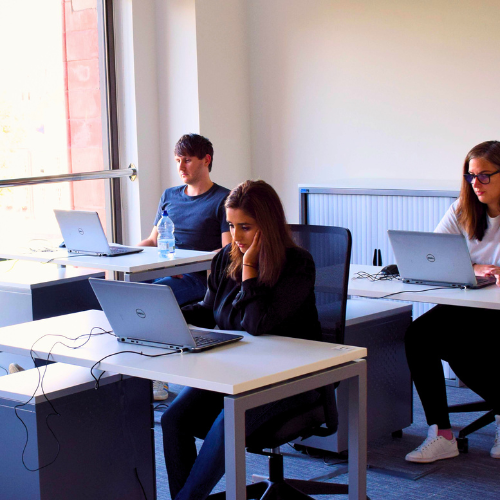
Three students sit at their desks taking an exam, facing the camera and looking at their computer screens. A window is to the left of the screen with sunlight streaming into the room - the two women and one man taking the test look very focused.

In her article, “Why Can’t Test Centers Catch Cheating Effectively?” Sophie Wodzak of the Duolingo English Test critiques traditional test centres, highlighting their vulnerabilities in preventing cheating, and proposes that Duolingo’s technology-led approach to test security surpasses them.

While it is important to identify all the risks associated with successful in-centre exams, as it is with any form of exam delivery, it is equally essential to acknowledge how exam centres are responding to these risks, and the methods they are putting in place to ensure success.  

The rapid development of technology-led remote exams has proven invaluable in times when students are unable to attend test centres, such as during the height of the Covid-19 pandemic – but this form of assessment does not come without its own risks. Unless closely managed, remote exams can fall victim to operator complacency in matters such as invigilator training and technical issues, resulting in a confusing and stressful experience for candidates. This is hardly acceptable even in a low-stakes assessment environment, but when it comes to high-stakes examinations, badly handled remote exams can have dire consequences for both candidates and awarding bodies.  

In her article, Wodzak suggests that human invigilators in test centres may miss subtle cheating behaviours as a result of overseeing too many candidates at once.  While it is true that human oversight isn’t infallible, many test centres have developed strategies to overcome this.  As well as simply hiring more invigilators, strategies can include rigorous training programmes, standardised monitoring protocols, and the integration of surveillance technologies to assist in real-time observation.  

Technological Enhancements in Test Centres 

Most modern test centres have embraced the incorporation of technology to bolster security.  Biometric verification, secure browser environments, and AI-driven behaviour analysis are all becoming standard in these environments.  A good example of this is China’s recent college entrance examinations, known locally as ‘gaokao’.  Test centres in several provinces, including Jiangxi and Hubei, incorporated AI systems to monitor candidates in real-time and flag any suspicious behaviour.  In Hubei, this technology was combined with smart security screenings, ID verification checks, and human pat-downs at test centres. 

It is clear how such tools help detect anomalies – such as candidates behaving unexpectedly, using unauthorised materials, or attempting to impersonate someone else – and can effectively bolster human oversight. 

Addressing Proctor Misconduct 

Wodzak raises concerns surrounding invigilator misconduct, such as instances where they have been found complicit in cheating schemes.  But these cases, whilst serious, are rare exceptions.  The vast majority of test centres and exam providers (like ourselves) have strict protocols in place – such as background checks, continuous training, and audit trails – to deter and detect any misconduct by staff.  

At VICTVS, our invigilators undergo rigorous, ongoing training to ensure they deliver a world-class service to every candidate, anywhere in the world.  This comprehensive training equips every member of the VICTVS Global Network to uphold the highest standards of exam security and academic integrity – while also providing real, in-person support to candidates when they need it most.

The Role of AI and Post-Test Analysis 

Wodzak references the Duolingo English Test’s use of AI to monitor and analyse thousands of test sessions simultaneously, detecting irregularities.  She contrasts this with in-person invigilators, who are limited to spotting only what they can see in real time.  However, this overlooks the fact that many traditional testing organisations now integrate AI into in-centre assessments.  These systems can flag suspicious behaviours for further review, as demonstrated in China’s gaokao exams mentioned above. 

Incorporating AI tools into in-person exams ensures a multi-layered approach to test security, as opposed to simply relying on AI oversight – which comes with its own risks.  False positives and negatives, and a lack of contextual judgement, are all pitfalls of using only AI to monitor or mark a candidate’s work.  Combining AI with professional invigilators balances efficiency with judgement. 

Conclusion 

While the DET presents innovative methods for ensuring test integrity, it’s important to recognise that traditional test centres are not static; they continually evolve, adopting new technologies and methodologies to combat cheating.  Both models have their merits and challenges, but a comprehensive approach that combines human oversight with technological tools – whether in person or online – is pivotal in maintaining the credibility of assessments. 


VICTVS Global Network Member Spotlight: Chiara Polledri

In this edition of our VGN Member Spotlight, we speak with Chiara Polledri, an experienced invigilator who has been part of the VICTVS team for over eight years.

Chiara first joined us in 2017 after spotting an opportunity to put her language skills to good use, and she’s been a valued member ever since.  Alongside her work with VICTVS, Chiara also tutors children and young adults, including refugees from conflict-affected areas.

Chiara, have you had any particularly memorable cheating experiences while invigilating with us? 

I’ve had two major episodes of cheating, with the worst in 2019.  I saw a candidate using an additional mobile phone.  They tried to take pictures of the exam papers because at this time, there were still physical exam papers. I approached the candidate, I took his phone and his paper and I said, “the exam has finished for you because I saw what you were doing. This is against the rules,” etc.  I gave back his phone, and he started shouting at me.  

Some candidates say, “okay, I was being silly,” and they drop everything and leave, but it depends on the candidate’s personality – some deny it and overreact.  This man started shouting at me and saying “I was doing nothing.  You didn’t see!”

This man was much older than me, and it’s hard when you’re dealing with an adult who already has a professional career.  He threatened me by saying his wife is a lawyer and we’ll see each other in court!  

I immediately called VICTVS and was assisted by my regional manager, who was in contact with the client and the centre staff as well, and the candidate was invited to leave the building.  As my regional manager said, “they can’t do anything,” so you know you’re doing the right thing.  

Can you tell me more about your job tutoring when you’re not working at VICTVS? 

A white woman with blonde hair smiles into the camera - this is a selfie. She wears a dark blue jacket and a VICTVS lanyard with a cream handbag.

Before Covid, I started tutoring children and young adults.  I have always loved working with children, tutoring them, and assisting them with their homework.  There’s a relationship of trust here as well, as sometimes they share with me concerns about their personal life. 

Since Covid, I’ve had more tutoring jobs because many children have parents who work for hospitals and medical institutions.  These parents were calling me, asking me to tutor their children.  They were doing insane shifts, 12-14 hours, and sometimes they also had Covid infections, so I really felt like part of a great community while tutoring these children, as not only was I assisting them, but I was assisting their family.  

These children had online lessons from elementary schools.  They were supposed to print papers, do their homework, and scan the paper back to their teachers and professors – the process was extremely different from the past.  Here in Italy, technology was not really considered in school before Covid, so everything was so new.  

I continue tutoring when I’m less busy with VICTVS because I feel that children and teenagers need so much support.  Sometimes, both of their parents are working and they need someone to sit next to them and encourage them, boost their confidence. 

I’m not a psychologist, but with empathy you feel that you’re contributing to their growth as a student and as an individual, because you’re boosting their confidence so they can discover their worth.  This is why I would like to develop my professional qualities in tutoring children and get a psychology qualification so I can support them 360 degrees.  

I know you work with many refugee children – what kind of support do you aim to provide for them?

I have a few children coming from post-conflict and ongoing conflict areas, because we have many Ukrainian children living in Italy since the war began in 2022.  These children often need so much support with their Italian because their parents are maybe busy working and integrating into Italian society, finding a job and supporting their families. So this has been an aspect of my work in tutoring that has developed since the Ukraine war, and also with the conflict in North Africa. 

Throughout the years, I have experienced children that only speak Arabic because their families only speak Arabic.  Of course, children learn fast, so maybe by the end of one year of tutoring, they are fluent in Italian.

I also have to customize classes according to children’s personalities, because sometimes they are a little bit shy and you have to make them feel comfortable.  Sometimes they’re very lively, so we have to set a proper schedule so they can have some rest but also get them to focus on their homework.  It’s very nice when you set up a system that brings about results.

I noticed that the main problem when coming from post-conflict or ongoing conflict areas is trying to forget about the past, because we don’t know what they saw before leaving their countries and sometimes they have been traumatized.  Trying to distract them from what happened and helping them integrate themselves into a new society with different rules…it makes you feel like you’re part of something great.

What made you want to study languages and what languages can you speak? 

Apart from Italian, I can speak English, Spanish, French, and Chinese. 

I have loved language foreign languages from the very beginning because of my aunt – she’s a professor of English – and I also have relatives in the UK because my grandmother’s sister, she moved there from Italy to be a nurse after the second World War.

I started studying English from elementary school, and then I chose high school for foreign languages. Then I started studying English and Chinese at universities, and I also visited France and Spain so I’ve had the chance to boost my speaking skills.  I’ve studied in China as well. 

When you are not working at VICTVS and tutoring, what do you like to do with your spare time?  

I love hiking!  This has been a great passion of mine, especially since Covid.  

I hiked when I was a child because all of my family, they love walking on the hills and the mountains.  I’m more a mountain team than a seaside team!  But since Covid, when all the gyms were closed and we had all the restrictions, I rediscovered the amazing part of being in nature.  It really gives me so much joy, and I can relax and detach from everyday life, because sometimes – if exams or tutoring sessions are quite tough – I need to recharge myself.

Just walking in the woods, hiking, it really does help me to relax and have a lovely time with my family and friends, because I have so many friends that love hiking as well.  When I go hiking, I feel that not only is my body working better, but also my mind.  

What are some current goals that you are working towards?  

I want to achieve my degree in foreign languages and international relations, because I’ve postponed it through the years, but I would really like to complete it – I’m due to do that next year. 

And then I would like to specialise in psychology for children and get qualified to tutor children at a higher level, teach Italian and provide psychological support for children coming from post-conflict and ongoing conflict areas.  

I also love foreign languages, so another goal would be to learn German and Russian.  But I have to see if my brain can cope with this!  

Delivering Assessments Across Borders: Lessons in Culture, Access and Inclusion

A graphic image of a globe in a blue/teal shade, with 3 people's outlines underneath. To the right, is a woman wearing traditional Muslim dress, to the left is the profile of a man and a woman with short hair.

Back in April, I attended the AO Forum on behalf of VICTVS, where I had the opportunity to hear from a range of expert speakers covering topics such as how to run an awarding organisation, AI, and robotics.  One standout session was delivered by Jonathan Ledger from the Department for International Trade.  His talk focused on how companies can successfully expand into global markets, and what that process should look like for long-term success. 

As VICTVS operates globally, Jonathan’s insights were particularly relevant.  I was especially interested in two key areas of his talk: the importance of conducting thorough, country-specific research before expanding into a new region, and the principle of total country inclusion.  On this second point, Jonathan argued that awarding organisations must deliver their services across entire countries, and stressed the need to reach learners in remote and underserved regions with equal commitment. 

While Jonathan’s talk was aimed at awarding bodies, these points are broadly applicable to a wide range of businesses, including assessment providers like ourselves.  There are specific challenges that we tackle while delivering exams on an international scale, and it is only by doing our homework on each country that we overcome them.  

The Importance of Cultural Homework 

Context matters when expanding business into new countries.  Every culture has it’s norms and it’s vital to do your homework on what they are – especially in areas like communication, decision-making and local traditions.  The book ‘Culture Mapping’ by Erin Meyer goes into this idea in greater depth, highlighting how there’s often invisible boundaries brought about by cultural differences that can hinder international collaboration.  

An example of cultural differences that we see in our everyday lives is humour.  In the UK, sarcasm and self-deprecation are common ways of connecting.  But this style doesn’t always translate.  In countries like America and Japan, British humour can sometimes lead to confusion.  

This might seem small, but in a global workplace, it really matters.  Cultural misinterpretations of humour can undermine trust, confuse communication, or accidentally cause offence.  That’s why it’s often best to avoid sarcasm, irony, or deadpan delivery in cross-cultural or high-stakes contexts unless you’re sure your audience shares the same references. 

Understanding these cultural nuances is essential when working with invigilators and test centre managers globally so that we can deliver high-stakes exams effectively in each region.  

There are also significant differences in how academic terms and educational systems are understood across regions.  For instance, in the UK, ‘college’ typically refers to post-16 education that isn’t university.  In India, it’s often an institution affiliated with a university.  In Ireland, it’s used interchangeably with ‘university,’ and in the Philippines, a ‘college’ usually refers to a faculty within a university. 

Failing to understand these distinctions can lead to confusion, miscommunication, and even reputational damage when working internationally. 

Infrastructure and the Global Digital Divide  

Access to digital infrastructure varies widely around the world, and this presents a significant challenge for global assessment delivery. 

In the UK and Europe, there are generally high levels of digital literacy and access to fast WiFi speeds – though exam candidates living in more rural areas can still struggle to find a strong connection.  

However, this isn’t the case across the globe.  In countries like Afghanistan, internet infrastructure is limited; this often results in very slow WiFi download speeds of around 5-10Mbps.  The same can be said for Ethiopia, which has a state-run telecom monopoly, and Sudan, the Democratic Republic of the Congo, and Zimbabwe.  

In many regions, low digital literacy is an additional hurdle – particularly in rural areas, where people may have limited access to devices, training, or reliable internet. 

At VICTVS, we respond to these challenges by offering a flexible range of assessment formats, including centre-based computer tests, paper-based exams, and fully remote assessments through our V3 platform.  This allows candidates and test centres to make an informed choice of format that best suits their local infrastructure and connectivity. 

We also collaborate with partners to create bespoke solutions.  For example, we are currently supporting assessments aboard a barge equipped with Starlink internet. This mobile centre travels to Gabon, the DRC, Cameroon, and Congo, delivering computer-based exams in remote regions with limited digital infrastructure.  This approach enables us to reach candidates in areas where education services are otherwise inaccessible. 

Providing extra options like this for those who need it really makes a difference and allows services to be brought to those in rural areas, who often need them the most. 

Total Country Inclusion 

The principle of total country inclusion referenced by Jonathan Ledger in his talk is an important one.  While every business should consider their global reach, when it comes to providing educational and assessment services, it is especially important.  

Every person should have the right to an education and the opportunity to earn a qualification, regardless of where they live.  But achieving this requires more than just technology; it requires cultural understanding, awareness of different regulatory frameworks, and an equal commitment to every learner – not just those in major cities. 

Reaching remote learners may involve overcoming logistical challenges, navigating diverse regulatory environments, or rethinking how assessments are designed and delivered.  It means ensuring that people in remote or underserved areas receive the same high-quality experience as those in better-connected regions. 

For VICTVS, total country inclusion is something we are always striving for.  It drives us to build global systems that work everywhere, not just somewhere. 

Unexpected Local Barriers 

Alongside the logistical challenges of delivering assessments globally, there are smaller challenges which need to be considered and overcome.  

We recently received an email from a candidate in Tehran, Iran, who had been experiencing difficulties while sitting a remote exam due to noise in their neighbourhood.  This candidate was worried that the noise of a street seller outside their window would violate exam rules which state that candidates should be doing their assessment in a quiet space.  

In this instance, ourselves and awarding bodies need to be understanding of the different environments people live in across the globe.  As well as noisy neighbourhoods, other factors such as climate, local events or political disruptions must be considered when arranging exams and talking to candidates.  

At VICTVS, the local invigilators we have around the world play a key role in keeping us informed about certain events and disruptions, enabling us to arrange exams that work for everyone. 

Local Insight Is Central to Global Success

Expanding into international markets isn’t just about scale or logistics, it’s about understanding people and places.  At VICTVS, our work delivering assessments around the world has shown that long-term success depends on more than just good infrastructure; it relies on knowing how to operate within each unique cultural and regional context. 

Whether it’s navigating local customs, working around limited connectivity, or adapting to unexpected conditions on the ground, every region brings its own set of challenges and opportunities.  These issues need to be treated as a priority and not as an afterthought, as dealing with them is central to doing the job well.  Global strategies must be built around local realities if they’re going to succeed.  

To be effective internationally, systems need to be built to a high standard, and to meet the needs of different communities. That requires more than just technology: it requires local knowledge, strong partnerships, and respect for each unique cultural context.  

At VICTVS, total country inclusion is a principle that shapes how we work every day.  This is because we believe that everyone, no matter where they are, deserves access to an assessment that is fair, secure, and designed with their context in mind. 

The Hidden Cost of Inefficiency in Exams

An abstract image, half yellow and half teal (split down the middle). An orange, zig-zag arrow points down, going across the page top-left to bottom-right, with a light yellow circle to the top-left.

The demand for secure and efficient in-centre exams is growing, as are the evolving needs of both awarding bodies and candidates.  Awarding bodies must be confident that the venue they use not only accommodates the required number of candidates, but also supports reasonable adjustments and the one-on-one invigilation these require.  Candidates also deserve to sit their exam in a comfortable, well-lit space, with the facilities necessary to support their needs. 

But even with the right space and intentions, inefficiencies in exam delivery can quickly undermine the candidate’s experience, as well as the integrity of the assessment itself.  From unclear processes at check-in, to inconsistent invigilation standards, small operational gaps can create delays, confusion, and unnecessary stress for everyone involved. 

We are closing these gaps in efficiency with the opening of our new test centre in the heart of London.  With state-of-the-art facilities and high-level security, our flagship test centre provides the highest standards of assessment integrity.  Before looking at how we are addressing these challenges in our own venue, let’s look at the broader impact of inefficiency in exams. 

The Hidden Costs of Inefficiency 

Inefficiency in exams can cause a number of different challenges which negatively impact exam days for both students, invigilators and institutions.  One of the most common and disruptive consequences is time loss.   

When key processes like ID verification and security checks rely on manual systems or unclear procedures, delays can build up.  This can slow down pre-exam checks and push back exam start times, undermining the professionalism and perceived integrity of the assessment, and potentially resulting in reputational damage for the awarding body.  

Inefficiency resulting from overcomplicated and un-streamlined processes can also result in technical disruption, something which contributes greatly to a stressful environment – especially since candidates are often fully reliant on technology to do their exam.   

This stress can be particularly harmful for candidates who are already under pressure.  Delays and confusion before an exam can interrupt focus, increase anxiety, and negatively influence performance.  In contrast, a calm and efficient environment helps candidates to feel composed and confident, setting them up for success.

On top of this, it’s important to acknowledge that some test centres may compromise on security for the sake of speed.  Corners may be cut when it comes to ID checks, metal detector checks, room scans, or invigilator vigilance, so that candidates can be moved into an exam quickly.  This creates opportunities for malpractice, undermining trust in the results and risking the exam’s integrity. 

Why Security Matters More Than Ever 

Security should always be at the forefront of anyone’s mind when planning and executing an exam.  For both remote and in-centre assessments, there are a number of security risks which need to be looked out for, but the risks associated with in-person exams come with their own specific challenges.  If handled poorly, security checks and processes at test centres can disrupt an entire room of candidates and delay the examination process, while remote exam delays typically only disrupt a handful of people. 

In a recent piece, we explored the challenges of verifying candidates’ identities, highlighting extreme cases of identity fraud – such as a man in Kolkata dressing up as his girlfriend to sit her exam.  This is a clear example of why security needs to be taken so seriously, as some candidates really will do anything to secure themselves a better grade.

With that in mind, it’s important that test centres have top-tier security measures, as well as clear procedures to follow when an incident occurs.  All venue staff should be trained to manage such incidents confidently and consistently.

These safeguards will be of particular concern to awarding bodies granting qualifications with high commercial or reputational significance, though it’s a factor that should be a top priority for all assessments.

Designed for Efficiency  

We have designed our new London test centre with efficiency and security at the forefront, creating an environment where awarding organisations can be confident in the integrity of their assessments, and candidates can remain calm and focus on their performance. 

Robust ID verification protocols and secure entry processes, including metal detectors and controlled access points, ensure that only authorised individuals can enter the exam space.  The venue itself is also monitored by CCTV and staffed by our own VICTVS staff and invigilators, who are experts in both exam procedures and candidate care.  By having complete management of both the building and venue staff, we also remove any opportunity for third-party miscommunication or corruption.

By having robust procedures, a streamlined entry process and expert staff, we can support awarding organisations in delivering high-integrity assessments, and give candidates the best environment to succeed.

Final Thoughts 

Inefficiencies in exams do more than just cause frustration; they compromise the integrity of assessments and create avoidable stress for candidates already under pressure. 

Security should never be treated as a mere box-ticking exercise.  Cutting corners to save time can lead to serious consequences, including identity fraud and cheating.  True efficiency isn’t about rushing through processes – it’s about ensuring they are clear, consistently followed, and designed with both integrity and the well-being of candidates in mind.

We have designed our new London test centre to close the operational gaps that can undermine even the best intentions.  By combining high-level security protocols with streamlined procedures, we aim to set a new standard – one where awarding organisations can trust in the process, and candidates can focus on performing at their best. 

To find our more about our London venue, get in touch here.  


VICTVS Global Network Member Spotlight: Mehnaz Bibi

We are shining a light on some of the amazing people who work in our VICTVS Global Network.  With over 5,000 members worldwide, our network is filled with inspiring individuals making a difference every day.  Through this series, we hope to highlight their incredible stories and achievements.

In this third interview, we shine a spotlight on Mehnaz Bibi and her extraordinary journey.

Mehnaz, you were the first person in your family to graduate from university – that’s an amazing achievement!  Can you tell me more about that experience?

I am from the countryside in Pakistan, where girls usually get married at the age of 18 and the ones who decide to go for higher study are expected to choose a career in the teaching field.  I was born and raised in a big family with four sisters and one brother.  My father and uncle both passed away and had believed in me, they motivated me.  I completed my fourteen year education and decided to work so I can make some money and go to university.

I got my basic education from Urdu Medium school. They used to teach us just one subject in English, so I mostly learned to speak the language on my own.  I am a big fan of cricket and in my childhood I used to listen to commentators and practice my English after them.  In COVID, when the world was shaken, I actually started teaching English to Chinese students.

I did my Masters in Public Administration with a focus on Project Management while working at the new U.S. Embassy Compound in Islamabad.  It was an amazing experience, full of learning.  During the day, I was practically involved in Project Management, and in the evenings, I was studying.

I would love to mention one of my friends who is senior to me, Aziz Fatima, a psychologist and professor in college.  She set a plan, helping me choose my university, programme, transport, etc.  I am so thankful to them, they fed me everyday, as I had no time for cooking because I was working during that time.A photo of a pale skinned woman with long brown hair, smiling at the camera

What advice would you give to other young women in Pakistan who want to follow a similar path in higher education?

My advice to young girls is nothing is impossible.  If you want to get a higher education and your parents can’t afford it, don’t give up.  Get something to support yourself, save some money and do it later.

What inspired you to embark on a career in international relations?

I wanted to work with an international organisation, where I can interact with different people from different cultures.  I am fortunate that I got the opportunity at a very early age.  I started my career as a receptionist with the U.S. Embassy Islamabad, and later got a better opportunity working in Occupational Health and Safety as an Administrative Assistant at the new U.S. Embassy Compound Project in Islamabad, Pakistan.

What is your favourite part of your job?

My favourite part of the job is virtually meeting different people from different parts of the world.

I hear you’re an avid runner.  When did you start running and how has it impacted your life?

I have been into sport since 2015.  I used to hike five days a week and then go cycling once a week.  I started running in 2023 and it has changed my life – it helps me go to bed with a clear mind and start the day with a clear mind.  The most important thing is that it has improved my mental health and I look younger.

Who are some people that inspire you?

Benazir Bhutto is my all-time inspiration.  She was the first woman elected to head a democratic government in a Muslim-majority country.

What are some current goals that you are working towards?

I want to do another Masters in Occupational Health and Safety and Environment Management, as this programme will help me give back to the community.  The world needs a green force, especially Pakistan.

The country is facing a number of environmental issues including air pollution, water pollution, noise pollution, climate change, pesticide misuse, soil erosion, natural disasters, and flooding.  Climate change and global warming are the most alarming issues risking millions of lives across the country.

Occupational Health and Safety (OSH) is also a significant concern in Pakistan due to poor workplace safety conditions, and a lack of awareness among business and workers.  The rate of accident and lost-time injuries is very high, especially in construction, manufacturing, mining and agriculture.  Most significant is the lack of incident and accident reporting.

After getting this degree, I would like to work in the developing sector.


When a Reasonable Adjustment Becomes Unreasonable

Reasonable Adjustments are a feature of assessment delivery whereby candidates may be granted exceptions to normal exam regulations, in response to their personal requirements.  RAs (as they are commonly referred to in the industry), are intended to ensure that individuals with disabilities or specific needs are not unfairly disadvantaged in comparison to their peers.  These adjustments help to ensure fairness in assessment, levelling the playing field without altering the fundamental nature of the exam – or compromising its integrity.

In recent years, almost all awarding organisations and qualifying bodies have reported increasing volumes of requests for RAs in their exam programmes.  In today’s world, personalisation of service has changed from an exception to the norm.  From streaming services that tailor recommendations, top-end shoemakers offering individually tattooed shoes, to tech that adapts to user behaviour, the consumer-first mindset has begun to influence how people interact with institutions, including educational and examination bodies.

No longer are assessments simply a case of sit down and get what you are given.  Candidates understand that they are individuals and that when it comes to the strangely human experience of going through a high-pressure exam, there is no reason why their individual preferences should not be catered for.

Or is there???

Whilst RAs are undoubtedly a well-motivated and very beneficial aspect of exam delivery, a growing number of candidates are now pushing the boundaries of RA requests and demanding what can only really be described as Unreasonable Adjustments.

Whilst there is no definitive list of Unreasonable Adjustments, useful examples include:

  • RA requests compromising assessment integrity. For example, if a candidate requests to skip an essential component of the exam that tests a core skill (like asking to avoid timed responses in an exam that assesses the ability to perform under pressure due to anxiety), this will obviously undermine what the exam is designed to evaluate.
  • RA requests place undue burden on the service provider. This includes logistical, financial, or operational strain that are disproportionate to the benefit gained.  For instance, requesting one-on-one supervision or a single candidate exam space in a test centre where capacity and staffing levels are finite.
  • The request creates an unfair advantage. The adjustment is meant to remove a disadvantage, not provide a competitive edge.  If a candidate asks for extra time without a clearly justifiable need, it risks giving them an unfair advantage over others.
  • The request alters the nature or standards of the qualification. For instance, asking for content to be simplified or excluded due to personal beliefs would cross the line, as it changes the expected outcomes or skills being assessed.

Is this cheating?

One interesting question is whether adapting an assessment to an individual’s requirements simply because they have requested it, is giving an unfair advantage to this candidate over another who may not be aware of any right to request an RA.  Many RA requests require supporting evidence – for example, a candidate requesting extra time in an exam due to SEN such as Dyslexia, will be asked to provide proof of their requirements.  However, a candidate requesting extra time due to anxiety, might not be required to provide the same level of evidence.  The anxiety might be due to the exam, and assessment administrators may feel uncomfortable challenging such instances due to current awareness of mental health issues in the workplace.

From an assessment security perspective, any vagaries in exam regulations create an opportunity for cheating.  If other candidates are being granted extra time in an exam for conditions that do not require proof, why would I not request extra time for myself?  This can quickly turn into something of an arms race where RAs accidentally become an extra element of competition in an exam.

The Role of Changing Consumer Expectations in Increasing RA Requests

As mentioned above, demands for RAs are increasing in almost every assessment context.  Young people from school age are conditioned to personalised content, encouraged to assert their personal identity and requirements, and consequently do not consider standardised delivery to be normal.

Other reasons behind the increasing demand for RAs include:

  • People expect flexibility. Candidates may believe that exams should adapt to their preferences, not just their needs.  This can blur the lines between accommodating a disability and catering to personal comfort.
  • Greater awareness and advocacy. Greater awareness of mental health, neurodiversity (e.g., ADHD, autism), and hidden disabilities is positive, but it also means more candidates are empowered to request adjustments, sometimes without understanding the limits of what is reasonable.
  • Increased focus on fairness and inclusion. Institutions are under pressure to demonstrate that they are inclusive and non-discriminatory, which can result in more lenient or broad interpretations of “reasonable” – particularly when staff at these institutions are liable to professional penalties if perceived to be discriminatory in any way.
  • Digitalisation and on-demand culture. In a world where services are instantly tailored (e.g., Netflix, Spotify, Amazon), candidates approach exams with similar expectations — that the system should cater to them, rather than the other way around.

This changing landscape creates tension.  Exam owners must balance fairness and accessibility with standardisation and integrity.

Whilst it is vital to support candidates with genuine need for reasonable adjustments, it equally important to maintain the credibility and challenge of the assessment for everyone.

Exam administration staff at awarding organisations and exam delivery specialists, must be supported in denying unreasonable requests and must be given a clear framework of response to refer to.  Continual monitoring and analysis of RA request data can help exam owners to identify any changes that are occurring.  The same applies to social media and open-source monitoring that can help awarding organisations to identify online discussion of their specific exam processes and any perceived weaknesses or security vulnerabilities relating to RAs.

Simply put, Reasonable Adjustments are intended to remove barriers, not standards.  Current trends and conditions create the risks of exploitation by those looking to gain an advantage over others, undermining of assessment integrity, and hugely increasing the cost of exam delivery.

Let us know what you think.  If you have a view, question or idea relating to this topic, please contribute to the discussion by leaving a comment below.  We read every comment we receive – even the spam, and we are very grateful to the members of our community who participate.

To find out how VICTVS can help awarding organisations and exam owners respond to this and all other challenges relating to global assessment delivery, contact us here or call our head office on +44 (0) 113 539 7056.